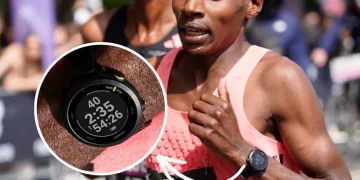







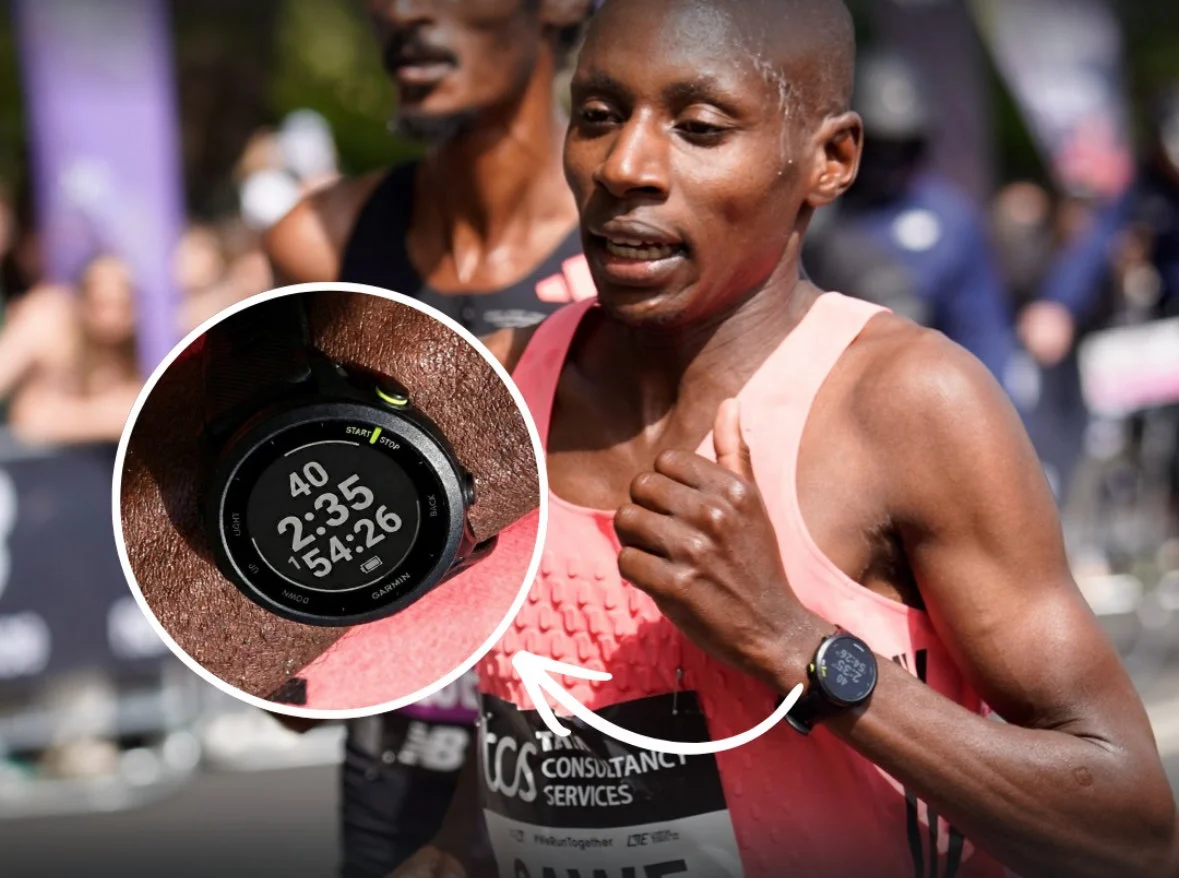
The world was stunned when Sebastian Sawe finally did what was considered impossible by becoming the first human to complete a 42 km marathon in under 2 hours. To beat the previous record and stop the clock at 1:59:30, he did so while tracking time on a simple Garmin watch, the Forerunner 55.
Usually, when people are part of an elite feat, like breaking the 2-hour barrier, you expect the most elite tech. However, the Kenyan was wearing what is an entry-level option.
To put it into perspective, the Garmin Forerunner 55 on the official site is currently priced at USD 199.99 (KES 25,890). Meanwhile, the top Forerunner model is the 970, currently priced at USD 749.99 (KES 97,093).
A Kenyan smartwatch website has priced the Forerunner 55 at KES 28,000 but this particular site has not listed the Forerunner 970.
One big thing about the Forerunner 55 is its weight: it’s only 37 grams and 1.04 inches. Every advantage counts in such a historic moment.
The watch comes with few advanced tech features. For instance, Sawe’s watch has a heart rate sensor, but it’s the Elevate Gen 3, which comes with no electrocardiography (ECG).
READ: Best Budget Smartwatches To Buy in Kenya 2025
It has no microphone, no LED flashlight, and no music storage for runners who love music while running. The Forerunner 55 also has no skin temperature tracking, no map feature, and no contactless pay NFC capability.
This watch also skips the AMOLED display and premium materials like titanium that one gets in high-end devices. It’s simply meant for entry-level and recreational runners, but it was used to break the marathon world record.
Sawe wearing it is a sign that high-performance runners continue to prioritize practicality and weight, favoring basic training watches over expensive, feature-heavy alternatives.
Difference Between Garmin’s Top Model and the Forerunner 55
| Feature | Forerunner 970 | Forerunner 55 |
| Price | $749.99 | $199.99 |
| Display Type | AMOLED | MIP (Memory-in-Pixel) |
| Display Size | 1.4 inch | 1.04 inch |
| Display Brightness | 2,000 nits | Standard MIP |
| Lens Material | Sapphire Crystal | Chemically Strengthened Glass |
| Bezel Material | Titanium | Fibre-Reinforced Polymer |
| Weight | 53g | 37g |
| Battery (Smartwatch) | Up to 15 days | Up to 2 weeks (14 days) |
| Battery (GPS) | Up to 26 hours | Up to 20 hours |
| GPS | Multi-band (dual-frequency) | Standard GPS/GLONASS/Galileo |
| Heart Rate Sensor | Elevate Gen 5 with ECG | Elevate Gen 3 |
| Maps | Full-color topographic maps | None |
| Speaker & Microphone | Yes | No |
| LED Flashlight | Yes | No |
| Music Storage | 32 GB | None |
| Skin Temperature | Yes | No |
| Garmin Pay (NFC) | Yes | No |
| Water Rating | 10 ATM (100m) | 5 ATM (50m) |
| Advanced Training | Running Economy, Running Tolerance, Impact Load, Triathlon Coach | Basic training with suggested workouts |
| Target User | Serious runners & triathletes | Entry-level & recreational runners |
Smart Watches at the London Marathon
There were other wearable brands in this historic marathon, where the Women’s-Only marathon record was also broken.
Tigst Assefa, the women’s champion, had another Forerunner model, the 255. Ethiopian Yomif Kejelcha, who finished in 1:59:41 in the men’s event, was wearing a COROS Pace 3.
COROS had something with the number two position, as Kenyan Hellen Obiri wore the COROS Pace 4 to finish second in the women’s event, crossing the line at 2:15:53.
Jocycline Jepkosgei, also of Kenya, had a more premium Forerunner model. She came third in the women’s event wearing a Garmin Forerunner 955. Kenyan websites price this particular model between KES 70,000 and KES 86,000.
Ugandan Jacob Kiplimo, who came third in the men’s event, producing a 2:00:28, was the surprise package. He wore a Samsung Galaxy Watch 8, a brand that has strong fitness features but is not a common sight among elite runners.