









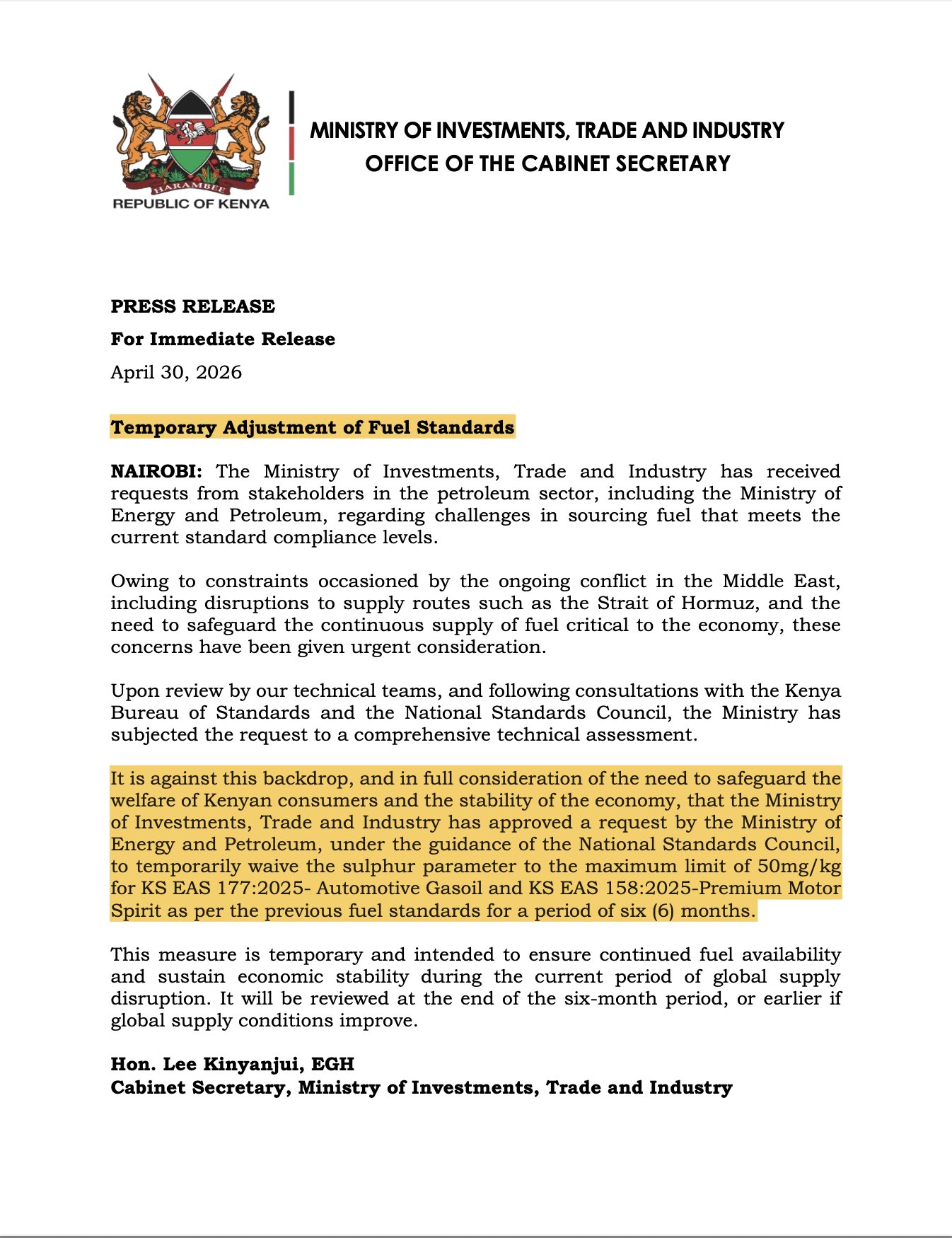
Kenya’s government has temporarily relaxed the sulphur content rules for two of the country’s most widely used fuels, Diesel and Super Petrol, citing supply disruptions linked to the ongoing conflict in the Middle East.
The decision, announced on April 30 by Cabinet Secretary Lee Kinyanjui of the Ministry of Investments, Trade and Industry, allows sulphur levels in both fuels to go up to 50 milligrams per kilogram.
That’s the old limit, the one that was in place before Kenya upgraded its standards under KS EAS 177:2025 for Diesel and KS EAS 158:2025 for Super Petrol.
The new, tighter standards had pushed for lower sulphur content, but suppliers are now struggling to meet those levels.
READ: Kenya Fuel Stocks Provide 16-Day Buffer, But Treasury Fears Middle East Delays
Why should Kenyans care about this? Well, sulphur in fuel burns to produce sulphur dioxide, which contributes to air pollution and acid rain. Lower sulphur fuel is also easier on modern engine systems and catalytic converters.
The global trend has been toward “ultra-low sulphur” fuels at 10-15 mg/kg. Kenya’s new standards were part of that shift, but now the waiver temporarily steps back from it.
The reason the government has given is that fighting in the Middle East has disrupted shipping routes, especially through the Strait of Hormuz, a narrow waterway through which a significant portion of the world’s oil and refined fuel passes.
If ships can’t move freely through it, fuel that meets Kenya’s upgraded specs becomes harder to source and more expensive to procure.
The request to relax the standards came from the Ministry of Energy and Petroleum and was reviewed by the Kenya Bureau of Standards and the National Standards Council before being approved. The ministry says it weighed consumer welfare and economic stability before signing off.
The waiver is set to last 6 months, though the government says it will review it sooner if supply conditions in global markets improve. The measure applies specifically to the sulphur parameter only. Other aspects of the fuel standards remain in force.
READ: Fuel Hike Pushes Matatu Fares Up to KES 190 in Nairobi
This kind of temporary standards rollback isn’t unusual globally, as countries have done similar things during supply shocks, but it does mean that for the next half-year, Kenyans may be filling up with fuel that produces slightly more sulphur emissions than what the updated national standards intended.
The government is betting that keeping fuel on the shelves matters more right now than holding the line on the new spec.