







Gen Z, you may want to sit this one out or, better yet, listen closely. Before Google was a verb, before every campus student had an AI helping them with their CATs, and before a WhatsApp chatbot became a family group member, there was Ask Jeeves.
On May 1, 2026, after nearly 30 years of trying to stay relevant, it finally logged off for the last time.
Back in 1996, there were no algorithms, no recommendations, nothing that knew what you wanted. You typed words into a box and hoped something useful came back.
Into this beautiful chaos came Ask Jeeves, a search engine named after the famously helpful fictional butler from P.G. Wodehouse’s novel that nobody under 30 has heard of. That part does not matter; what does is what it could do.
The concept was radical for its time. You could type a full question in plain English, and Jeeves would try, really try, to answer you.
“What is the capital of Turkmenistan?” or “How do I remove a grass stain?” worked. You were not really feeding into a machine, but rather you were supposedly asking a very patient gentleman in a tailcoat.
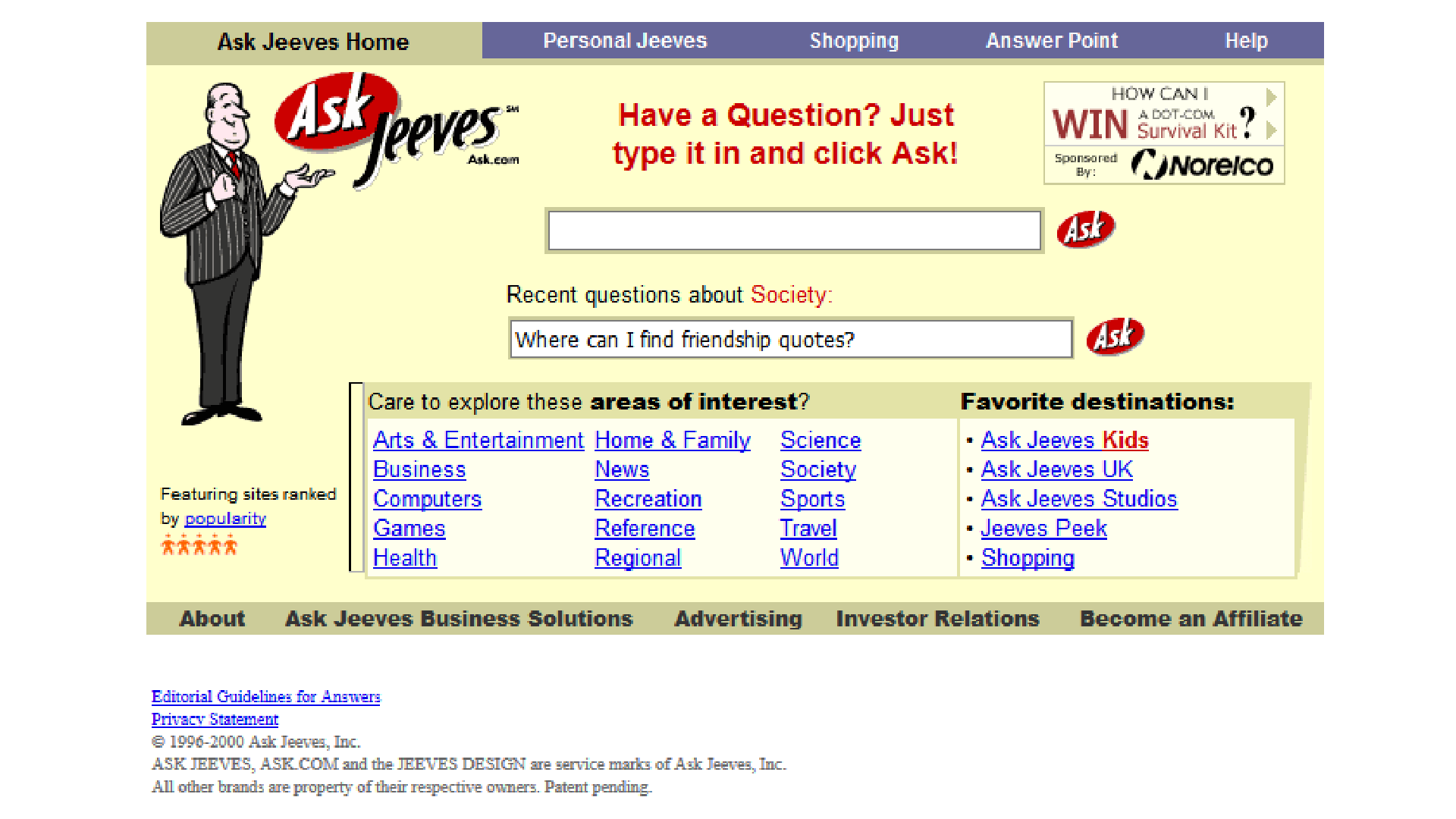
At its peak in the early 2000s, Ask Jeeves was one of the most recognizable names on the internet. People used it the way people use Google or ChatGPT today for everything. It was, in many ways, the spiritual grandfather of every AI assistant that exists today.
Then Google happened. The PageRank algorithm, introduced in the late 1990s, did not care about how polite your question was. It cared about relevance, authority, and the sheer scale of the web.
Google indexed faster, ranked better, and delivered results that felt almost psychic by comparison. Ask Jeeves, meanwhile, was relying partly on human editors to manually curate answers. It was a beautiful idea, but deeply impractical at an internet scale.
By 2006, the company quietly dropped “Jeeves” from the name and became just Ask.com. It was rebranding that, with hindsight, felt like removing the personality from a personality.
They tried pivots, including a return to Q&A in 2010, essentially trying to become what Quora is today, a place where real people ask real questions and get real answers, but it was not enough.
IAC, the holding company that bought Ask Jeeves in 2005 for nearly $2 billion, eventually accepted that they could not win the search war and began pulling investment. The butler’s hours were cut and then his position was eliminated entirely.
What finished Ask.com was not just a smarter competitor but something far more total, a slow, industry-wide massacre that the tech world has quietly started calling Death by AI.
READ: Reddit Is Quickly Becoming the New Way to Search the Web
The technology that Ask Jeeves pioneered, natural language queries, understanding questions the way humans ask them, was eventually perfected by the same forces that made it obsolete.
When ChatGPT arrived in late 2022, it did not just answer questions. It had conversations, wrote essays, debugged code, and did your thinking for you.
Why type a question into a search bar and scroll through links when a chatbot would simply hand you the answer, polished and ready?
AI’s Death List
The thing about a massacre is that it rarely announces itself, so when ChatGPT launched in November 2022, Chegg was still worth billions, photographers were still selling stock images to pay rent, and nobody had any idea the ledger had just opened.
Ask.com held on for three more years but its fate was already sealed.
| Platform / Industry | What it was | What AI did to it |
| Ask.com | One of the internet’s first natural language search engines | Rendered obsolete by chatbots that answer questions directly; shut down May 1, 2026 |
| Chegg | US homework help and textbook rental platform worth $14 billion at peak | ChatGPT wiped its core business within five months of launching; stock collapsed 99%, erasing over $14 billion in value |
| Duolingo | Language learning app | Announced mass layoffs in 2024 and 2025, explicitly citing AI replacing contractor roles |
| Stock photography (Getty, Shutterstock) | Multi-billion dollar industry selling licensed images | AI image generators like Midjourney produced billions of images monthly by 2025; Getty’s creative segment declined, forcing a $3.7 billion merger with Shutterstock |
| HubSpot | Marketing software and content platform | Lost 70 to 80% of organic search traffic between late 2024 and mid-2025 as Google’s AI Overviews absorbed clicks |
| Business Insider | Major digital news publisher | Lost 55% of search traffic between 2022 and 2025, resulting in 21% staff cuts |
| Fiverr | Global freelance marketplace | Cut 30% of its workforce in 2025, repositioning itself as an “AI-first” company |
| Entry-level copywriting | Junior writers producing ads, blogs, and web copy | Entire job category quietly eliminated across hundreds of companies post-2022 |
| Customer service roles | Call center agents and support staff globally | Over 80,000 US customer service positions cut between 2022 and 2024, with AI chatbots absorbing the workload |
| Freelance translation | Human translators and interpretation services | Employment growth fell measurably in regions with high AI translation tool adoption |
| Salesforce support teams | Customer support workforce at one of the world’s largest CRM companies | CEO Marc Benioff cut 4,000 support roles in 2024, stating AI now handles half the company’s work |
| Quora | Crowdsourced Q&A platform once valued at $2 billion | Traffic and relevance gutted as users ask chatbots directly instead of posting questions and waiting for humans |
| Online publishers broadly | Blogs, media sites, and content platforms relying on search traffic | Publishers reporting 20 to 90% traffic losses in 2025 as AI search summaries eliminate the need to click through |
| Dropbox | Cloud storage and productivity platform | Cut 528 jobs in 2024 to refocus around AI tools, acknowledging the old model needed fewer people |
| Medical transcription | Specialists converting recorded clinical notes into text | Employment projected to decline 4.7% through 2033 as AI transcription tools take over |
Ask Jeeves spent decades ahead of its time, building a product premised on the idea that people wanted to ask questions and get direct answers. Every major AI product that now dominates the conversation is built on exactly that premise.
Jeeves was right; he just arrived 30 years before anyone had the computing power to do it properly.
Now, even Google, the company that made Ask Jeeves irrelevant, is scrambling. Its search results now feature AI-generated summaries at the top of the page because if you do not give users an answer, they will go find a chatbot that will.
The search engine war has a new front, and the old battles feel very far away.
Rest well, Jeeves. You were one of the good ones.