





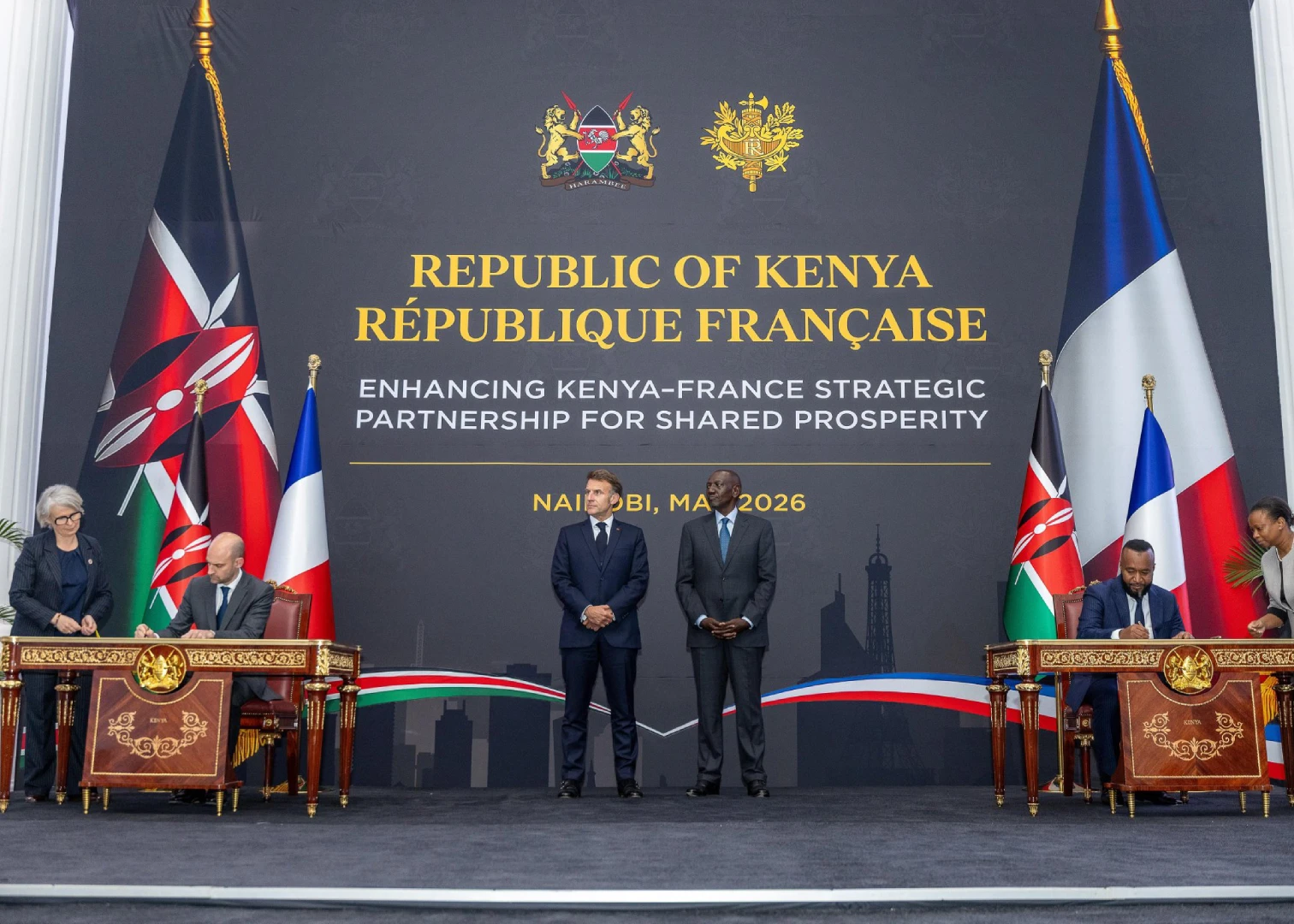
After what was a busy week for Kenya’s capital, the Africa Forward Summit has finally wrapped up, with France and African heads of state adopting a sweeping declaration that covers everything from security and agriculture to debt reform and AI.
Co-hosted by Kenyan President William Ruto and French President Emmanuel Macron, the summit was the first of its kind to be held on African soil, a detail the organizers leaned heavily into as a signal of a shifting dynamic in Africa-France relations.
The Nairobi Declaration, as it has been formally titled, runs across 11 thematic pillars. Buried inside the 11-pillar document is a tech agenda that is worth reading carefully, because it frames Africa’s digital future in terms that go beyond the usual connectivity talking points.
The signatories committed to what the document calls a “third path” for Africa in the AI age. One that is not tethered to the American tech ecosystem or the Chinese one but is instead grounded in strategic autonomy, reduced dependence on concentrated technological power, and African-led ownership of data and AI systems.
That is a significant thing to put in a joint France-Africa declaration, and it sets the tone for everything else in the tech commitments.
The most concrete expression of this is a push to build out the full African AI stack from the ground up. The declaration commits to supporting African language models, local datasets, open-weight AI systems, and open-source infrastructure.
It also calls for investment in regional data centers, broadband connectivity, and cloud compute capacity powered by clean energy.
The AU Continental AI Strategy and the AfCFTA Digital Trade Protocol are named as the guiding frameworks, with the Paris AI Action Summit of 2025 cited as a prior foundation to build on.
This is important because Africa’s current position in the global AI economy is largely that of a data source rather than a value creator.
The models being trained on African languages, African content, and African user behavior are overwhelmingly built and monetized elsewhere.
As such, the declaration’s push for African-owned data systems and local AI development is an attempt to change that equation, though the distance between a political commitment and a functioning language model ecosystem is considerable.
The AfCFTA Digital Trade Protocol got specific attention as well. Cross-border data flows, digital interoperability between member states, and market access for African startups and AI-enabled enterprises are all named as priorities.
This builds on momentum already established at the Connected Africa Summit 2026, held earlier, where African governments and telecom stakeholders made interoperability a central agenda item, pushing for seamless cross-border connectivity as a prerequisite for any serious digital single market.
READ: Connected Africa Summit 2026 Opens in Nairobi to Push Africa’s Digital Unity
The Africa Forward Summit’s endorsement of the AfCFTA Digital Trade Protocol lands in that same current. For founders building across multiple African markets, regulatory fragmentation remains one of the biggest structural drags on growth.
A startup that works in Kenya does not automatically work in Rwanda, Ghana, or Senegal, even when the product is identical and the need is the same.
Different licensing rules, data laws, and payment systems across borders eat into costs and slow everything down. Having two world leaders put interoperability in writing does not solve that overnight, but it makes it harder for regulators and trade negotiators across the continent to keep kicking the problem down the road.
The declaration also touches on creative intellectual property, which does not always make it into tech conversations. African music, art, and cultural content feeds enormous amounts of AI training data and generates huge streaming revenue globally, yet very little of that value finds its way back to the creators.
The declaration commits to protecting African creative IP in the context of AI and expanding market access for African cultural enterprises. The how is still unclear, but at least it is named.
All of this requires energy and money, and the declaration takes both seriously. On energy, renewable investment, including geothermal, gets a specific mention as the foundation for industrial growth.
That is relevant for Kenya, which already has significant geothermal capacity. Running data centers and computer infrastructure is expensive in power terms, and treating clean energy as productive economic infrastructure rather than just a climate commitment is the right framing.
READ: Kenya’s $1 Billion Microsoft AI Data Center Project Stalls Over Electricity Limits
On money, the summit was blunt about the problem. Structural overcapacity in major economies and unfair trade policies are making it harder for African industries to compete. They are also keeping borrowing costs high and discouraging long term investment.
France and Kenya were asked to take that message to the G7 Summit in Evian in June 2026. Without affordable long term financing, Africa cannot build the infrastructure needed for an AI-driven economy.
Kenya has spent years positioning itself as the continent’s technology hub, and the commitments in the Nairobi Declaration on AI sovereignty, digital trade, computer infrastructure, and clean energy map almost exactly onto what that ambition requires.
Hosting the Africa Forward summit here was a signal about where African tech is expected to grow from.