






East Africa finance ministers spent the second week of June talking about digital superhighways and the fourth industrial revolution. However, the actual budget numbers revealed a completely different narrative.
A CIO Africa report, The Budget Tells the Truth, pulled apart the 2026/27 budget estimates for Kenya, Uganda, Tanzania, and Rwanda and found a pattern that should worry anyone counting on government to fund the next phase of Africa’s digital growth.
The money isn’t going where the speeches point but to the parts that collect tax, not the parts that build digital infrastructure.
Kenya’s Flagship Digital Budget Vote Shrinks
Kenya provides a clear example. Despite having a national budget of about KES 4.7 trillion, funding for the digital economy and creative industries dropped to KES 8 billion, down from KES 12.7 billion the previous year.
That’s a cut of almost a third, delivered in the same Treasury speech that called digital transformation a strategic enabler of the fourth industrial revolution.
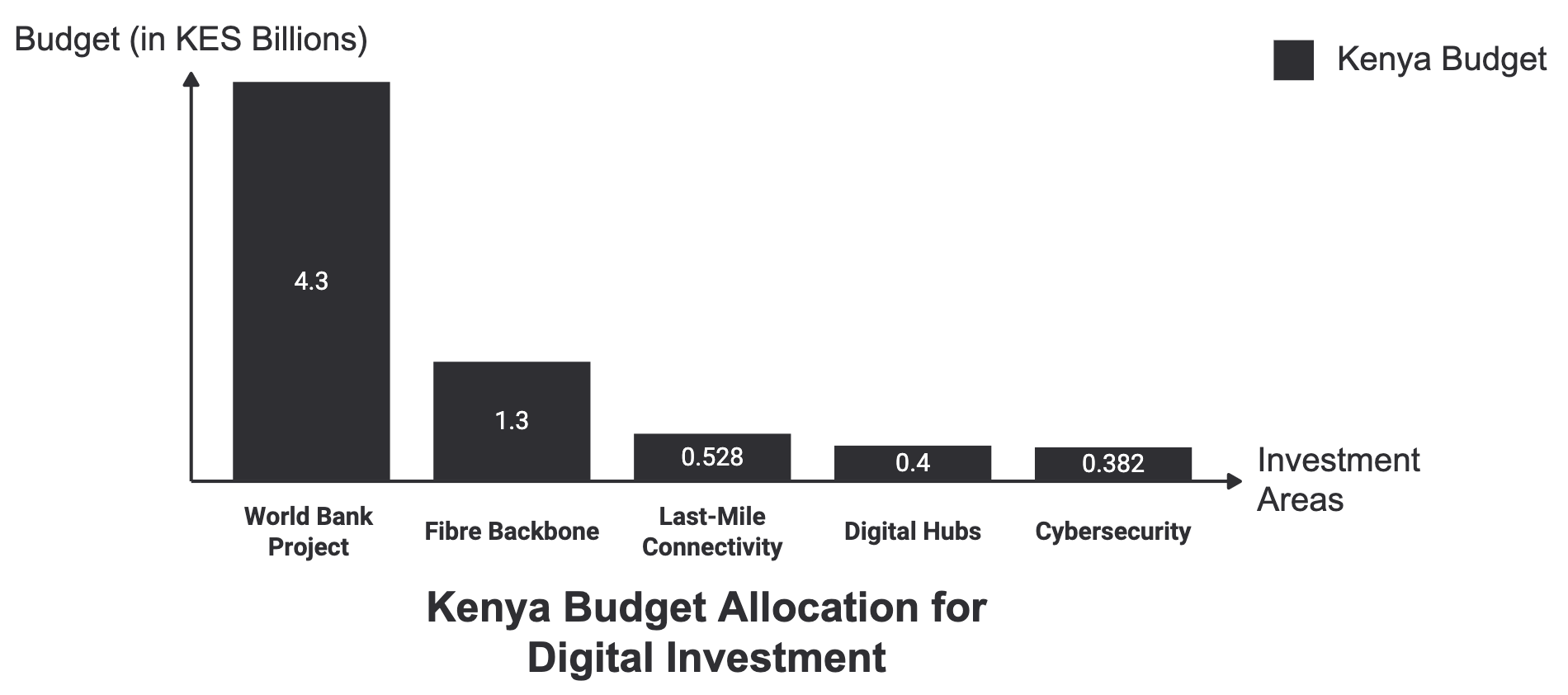
A closer look at the KES 8 billion reveals a much smaller picture. About half of the amount, KES 4.3 billion, comes from a single World Bank-backed project, the Kenya Digital Economy Acceleration Project.
The locally funded projects are much smaller, including KES 1.3 billion for fiber backbone maintenance, KES 528 million for last-mile county connectivity, KES 400 million for digital hubs, and KES 382 million for cybersecurity on the digital superhighway.
Meanwhile, the Konza data center and KAIST, which have appeared in previous budgets, received little attention this time.
Meanwhile, the Kenya Revenue Authority’s eTIMS electronic invoicing system, which validates tax returns directly against transmitted invoice data, is getting serious institutional backing.
KRA has even built a dedicated data-recovery site at Konza just to protect it. When a government builds disaster recovery infrastructure for a tax system but lets its flagship data center project go quiet, that tells you where the real priority sits.
The Same Pattern, Different Countries
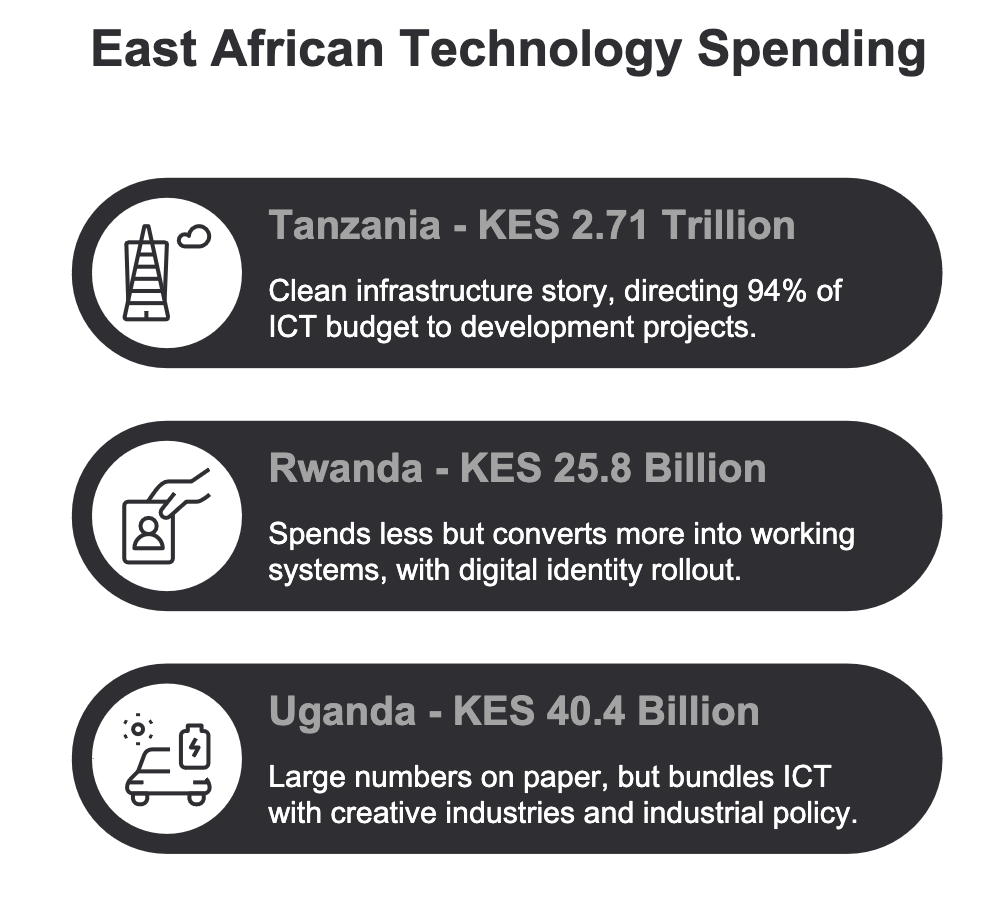
Kenya isn’t unique. Tanzania’s Revenue Authority is expanding its digital tax platforms toward an ambitious TZS 55-trillion (KES 2.71 trillion) target. Rwanda’s cashless drive has pushed retail e-payments to extraordinary levels relative to the size of its economy.
Across the region, the most aggressive technology spending isn’t happening in connectivity ministries. It’s happening inside the agencies that collect money.
That doesn’t mean every country looks the same. Tanzania actually delivered the cleanest infrastructure story of the four, directing 94% of its ICT ministry budget to development projects rather than recurrent spending, a ratio most ministries on the continent can only dream of.
Its priorities are concrete, including rural towers, national data centers, 5G expansion, and a cross-border fiber extension into the Democratic Republic of Congo.
Rwanda, true to its reputation, spends less than its neighbors but converts more of it into working systems, with its digital identity rollout riding on a $200 million (KES 25.8 billion) World Bank project that’s already past the halfway mark.
Uganda’s numbers look the largest on paper, slightly over UGX 1.14 trillion (KES 40.4 billion) for science, technology, and innovation.
However, that figure combines ICT with creative industries and industrial policy, covering projects such as Kiira Motors’ electric vehicles and the new Hi-Tech City. It is more of an industrial development budget that includes technology, rather than a budget focused only on digital projects.
What It Means for the East Africa Tech Industry
The report’s main point is about where new opportunities are emerging for technology vendors and what businesses need to prepare for. Right now, much of the digital infrastructure being built across the region is still funded by donors rather than local budgets.
READ: KRA Seeks Bidders for Billion-Shilling Tech Overhaul
Compliance tools, especially for e-invoicing, tax systems, and digital identity, have become a growing technology category rather than just an internal business expense.
For businesses, keeping accurate e-invoicing records is now a major concern because systems like eTIMS can reject expenses that are not supported by compliant invoices.
The uncomfortable truth in all these discussions is simply that governments across East Africa are still talking about digital transformation in the loudest possible terms.
When you look at where the actual spending is going, the focus appears to be on systems that collect revenue and enforce compliance rather than the wider digital economy described in government speeches.
For Kenya, the gap between those promises and the actual budget is becoming harder to overlook. It raises questions about whether the country’s AI and digital goals can be achieved with a shrinking ICT budget.