






Kenya’s appetite for imported tech gadgets is growing far faster than its ability to sell its own tech abroad, and April 2026 numbers make that gap impossible to ignore.
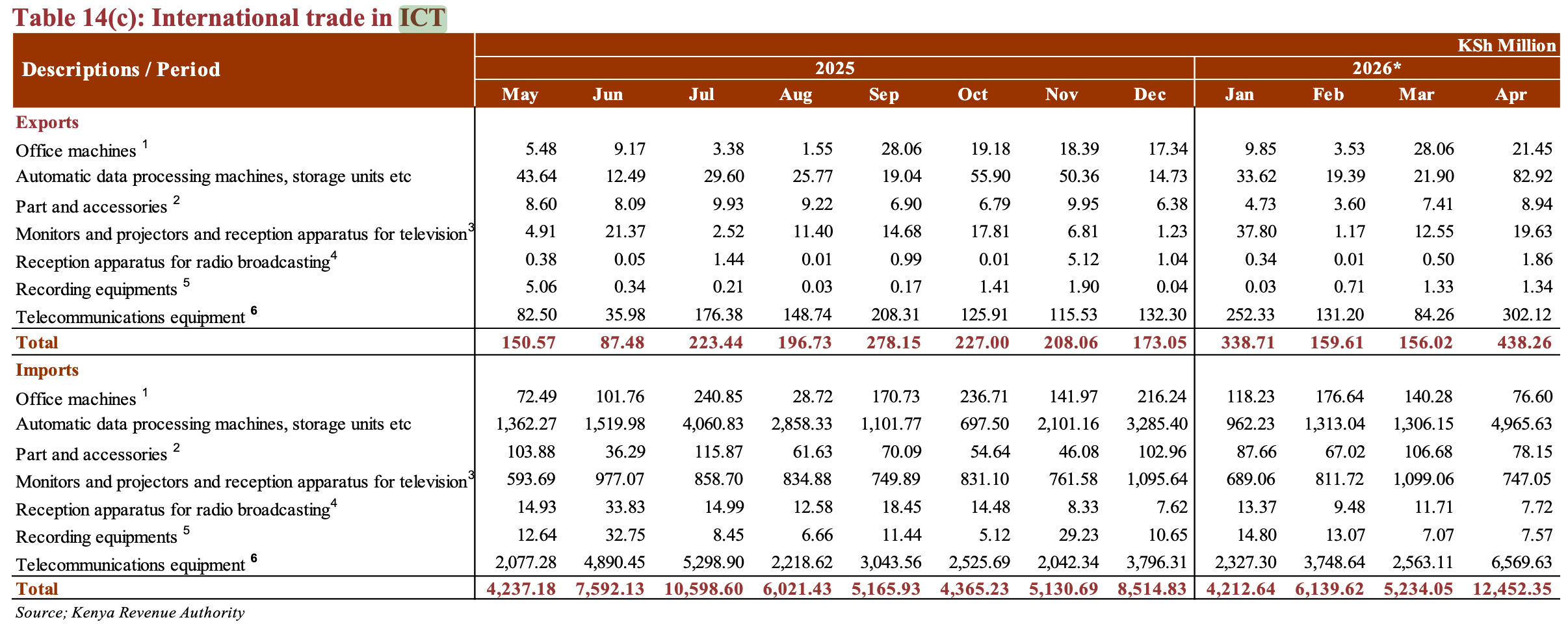
Exports of ICT equipment more than doubled in a single month, climbing from KES 156 million in March to KES 438.3 million in April, as reported by the Kenya National Bureau of Statistics (KNBS).
The biggest driver was telecommunications equipment, a category that covers things like phones, networking gear, and transmission apparatus, which saw exports more than triple from KES 84.3 million to KES 302.1 million.
On the import side, the growth was just as sharp but on a much bigger scale. ICT imports more than doubled too, jumping from KES 5.2 billion in March to KES 12.5 billion in April.
Two things pushed that number up. Automatic data processing machines and storage units, basically computers, laptops, and storage hardware, tripled in value from KES 1.3 billion to KES 5 billion.
READ: Kenya’s Tech Sector Grew in 2025 but the Cost of Living Got Worse
Telecommunications equipment imports also doubled, rising from KES 2.6 billion to KES 6.6 billion.
Kenya imported roughly 28 times more in ICT goods than it exported in April. That gap isn’t new, but it widened considerably this month, suggesting businesses and consumers are buying more tech hardware from abroad even as local tech exports grow off a small base.
Mobile money told a more mixed story. The number of active mobile money agents actually fell, dropping from 621,400 in March to 548,000 in April, a drop of over 73,000 agents in a single month.
READ: M-Pesa, Airtel Money Hit Over 600K Mobile Money Agents in Kenya
Yet total subscriptions kept climbing, reaching 92.8 million from 91.4 million, a figure that counts every wallet whether it’s actively used or sitting dormant.
Despite more registered accounts, actual usage slipped. The number of transactions fell from 217.9 million to 212.3 million, and the total value moved through mobile money dropped from KES 693.4 billion to KES 681 billion.
READ: Kenyans Moved KES 41.7 Trillion Through M-PESA in a Single Year
So while more people technically have mobile money wallets than ever, fewer transactions are happening and less money is moving through the system, even as the network of physical agents serving customers shrank noticeably in just one month.