







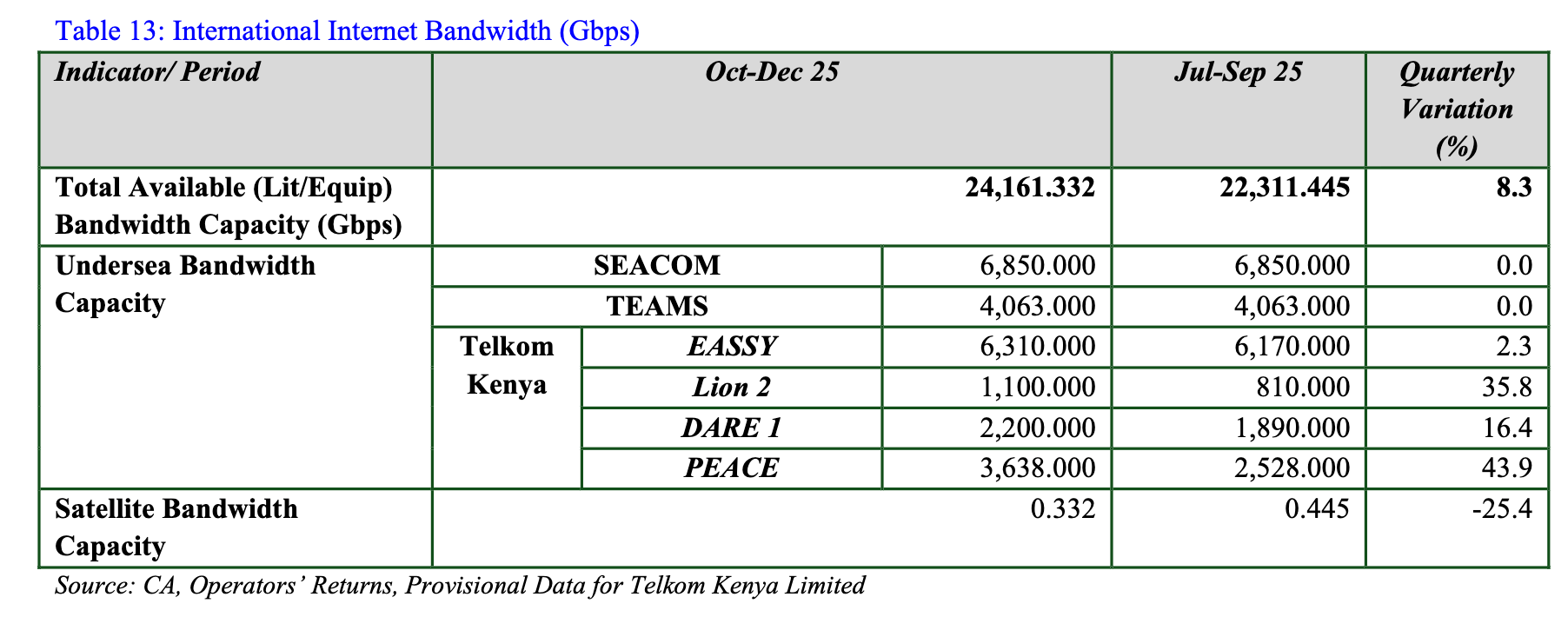
Kenya’s total available international internet bandwidth reached 24,161.332 Gbps by the end of December 2025, up from 22,311.445 Gbps three months earlier.
This 8.3% quarterly increase is notable on its own, but a closer look at where this growth is coming from shows a more important shift in Kenya’s role within global internet infrastructure.
The PEACE cable (Pakistan and East Africa Connecting Europe) contributed the single largest capacity addition in the quarter, jumping from 2,528 Gbps to 3,638 Gbps. That is a 43.9% increase in a single quarter from one cable system.
The Lion 2 cable (Lower Indian Ocean Network 2) grew 35.8%, from 810 Gbps to 1,100 Gbps. The EASSy cable operated by Telkom Kenya added 140 Gbps, a 2.3% increase.
Meanwhile, the long-standing cables (SEACOM at 6,850 Gbps and TEAMS at 4,063 Gbps) held steady with no change. These are mature systems operating at their equipped capacity. The growth is coming from the newer infrastructure.
Capacity vs. Usage
Having bandwidth available and actually using it are different things. The utilization data shows that 17,233.813 Gbps was consumed during the quarter, up 22.5% from 14,066.326 Gbps the prior quarter.
That’s a steeper growth rate than capacity expansion, meaning Kenya is filling its pipes faster than it’s building them. Of that utilized bandwidth, 14,279.661 Gbps was sold to users in Kenya, and 2,953.820 Gbps was sold to other countries in transit.
The transit figure being constant at 2,953.820 Gbps for both quarters suggests Kenya is serving as a pass-through for neighboring countries, traffic that enters through Kenya’s submarine cable landing stations and continues inland to Uganda, Rwanda, South Sudan, and beyond.
This transit role is not accidental, as Kenya has invested for over a decade in terrestrial fiber linking Mombasa’s cable landing stations to the interior and to neighboring landlocked countries.
That infrastructure is what makes transit business possible, and the consistent transit volumes suggest it has become a reliable part of the regional internet architecture.
Why Is the PEACE Cable So Important?
PEACE is newer than SEACOM and TEAMS and follows a different route, connecting East Africa to South Asia and Europe via the Middle East rather than the traditional round-Africa path.
It offers redundancy such that if the main western routes are disrupted, PEACE provides an alternative path. More practically, it offers lower latency for traffic going to destinations in South Asia and the Middle East, which is relevant for business communications and services hosted in those regions.
The 43.9% capacity growth on PEACE in a single quarter likely reflects a combination of factors, including new customers signing capacity agreements, existing customers upgrading their allocations, and the cable system being brought to higher utilization as it matures.
Submarine cables are typically built with far more fiber than is immediately activated; the process of “lighting” new capacity as demand justifies it is a normal part of how these systems work.
What The Utilization Rate Means For Kenyan Users
The 22.5% quarterly growth in consumed bandwidth (from 14.1 Tbps to 17.2 Tbps) maps directly to what’s happening at the user level. Mobile broadband consumption grew 12% in the same quarter, reaching 755,095 TB total.
Fixed internet subscriptions grew 7.4%. More people are online, spending more time online, doing more data-intensive things.
The utilization rate, calculated by consumed capacity divided by available capacity, is approximately 71%. Operational convention in network management typically aims to stay below 70-80% utilization to allow for traffic spikes and to avoid congestion.
Kenya is at the upper edge of that range, which helps explain why capacity expansion has continued at pace.
If mobile broadband consumption continues growing at 12% per quarter, which compounds quickly, the pressure on international bandwidth will intensify.
The decisions being made now about which cable systems to expand and at what cost will directly affect internet quality for Kenyan users and pricing for both consumers and businesses over the next several years.
Kenya’s submarine cable portfolio now includes SEACOM, TEAMS, EASSy, Lion 2, DARE 1, and PEACE, 6 distinct systems connecting the country to global internet infrastructure.
The diversity reduces dependence on any single cable and gives network operators and internet service providers competitive options when purchasing international capacity.
That said, all of these cables land at the Kenyan coast, meaning a physical disruption at or near the landing stations would still affect multiple systems simultaneously.
The last major incident of this kind (cable cuts in the Red Sea in early 2024) disrupted internet access across East Africa before alternative routes absorbed the traffic.
Kenya’s growing portfolio of diverse cable systems makes it more resilient to such events but does not eliminate the risk.
The 24 Tbps of available capacity and 17 Tbps of consumed capacity represent a country that has built substantial internet infrastructure in a relatively short time. The challenge now is sustaining the pace of expansion as usage continues to grow.