








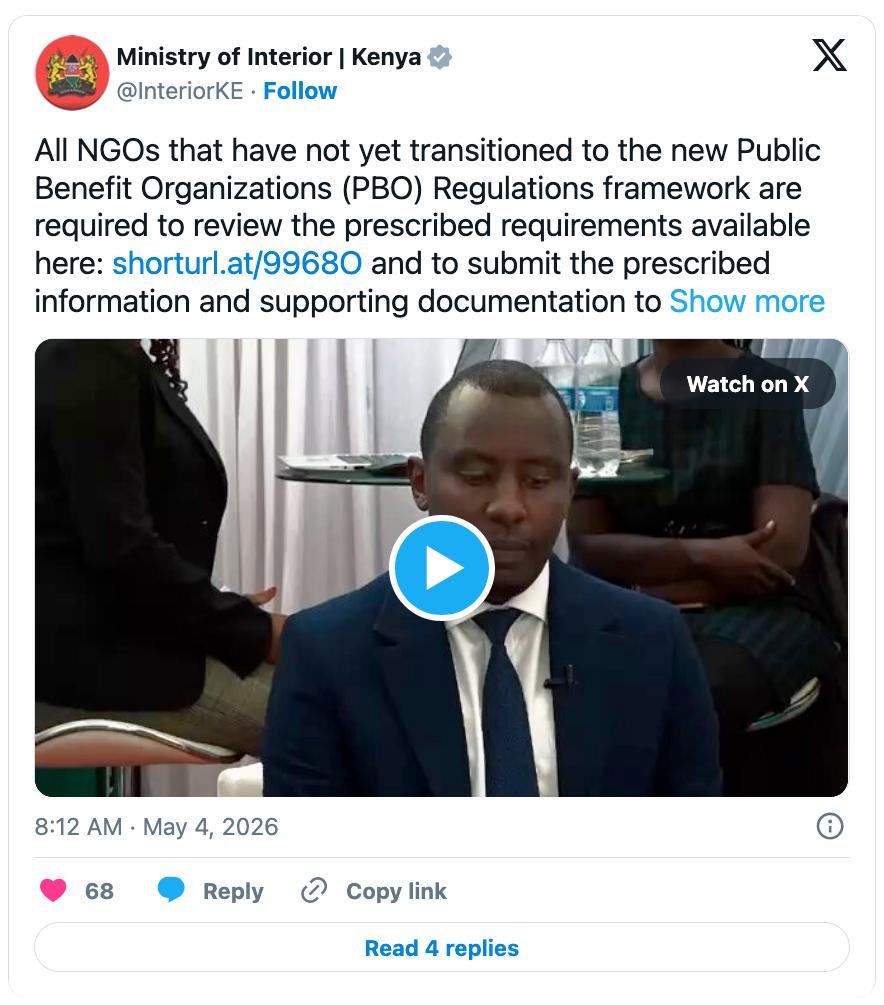
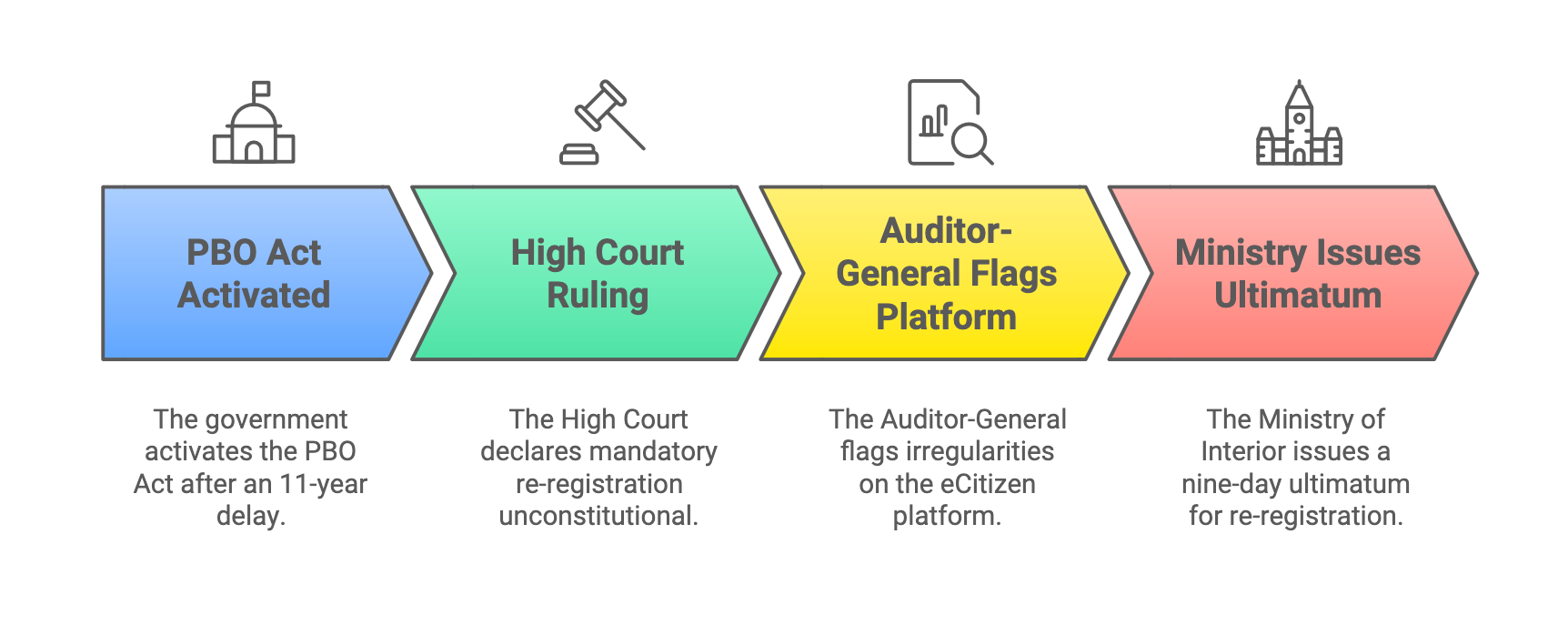
The Ministry of Interior and National Administration has issued what amounts to an ultimatum that non-governmental organizations (NGOs) yet to transition to the new Public Benefit Organizations (PBO) regulatory framework have 9 days to comply or risk losing their legal standing in Kenya.
The deadline has been set for May 13, 2026.
This directive stems from the Public Benefit Organizations Act of 2013, a law that sat dormant for 11 years before the government finally activated it in May 2024.
In theory, the PBO Act modernizes how civil society groups are governed in Kenya, replacing an outdated 1990-era framework and establishing the Public Benefit Organizations Regulatory Authority (PBORA) as the new oversight body.
In practice, the transition has been anything but smooth, and Monday’s ultimatum is the latest episode in a protracted and consequential fight over civic space.
The High Court Said No to Re-registration
The most significant complication for the Ministry’s directive is a ruling delivered on April 30, 2025. In the case Otieno and Two Others v. Attorney General and Another, the High Court of Kenya found that mandatory re-registration under the PBO Act was unconstitutional.
The court struck down the specific provisions requiring NGOs to reapply from scratch, ruling they violated the constitutional right to freedom of association and the principle that organizations with valid registration should not be forced to re-earn it.
It’s remedy was that PBORA should automatically transition all organizations that held valid registration under the old NGO Coordination Act before May 14, 2024, without requiring fresh applications or fees.
The recent Ministry directive effectively asks NGOs to ignore that ruling and proceed with the process the court said was unlawful.
“Re-registration requirement was declared unconstitutional, and all NGOs are expected to automatically transit.”
Civic Freedoms Forum – CFF
The Government Portal Under Legal Challenge
Beyond the constitutional question, organizations point to a second, more practical obstacle: the eCitizen platform that PBORA has designated for processing the transition has itself been declared illegal as currently configured.
NGOs argue the platform forces applicants to submit forms and pay fees drawn from the old, repealed NGO Coordination Act rather than the new PBO Act, creating a legal absurdity where compliance with the new law requires operating under the terms of the old one.
The credibility of the platform took a further blow in March 2026 when the Auditor-General flagged significant financial irregularities in the eCitizen system, as reported by NTV.
Reports of billions of shillings unaccounted for or irregularly diverted have made organizations reluctant to route sensitive data and institutional fees through what they regard as a compromised channel.
Why 2027 Could Be at Stake
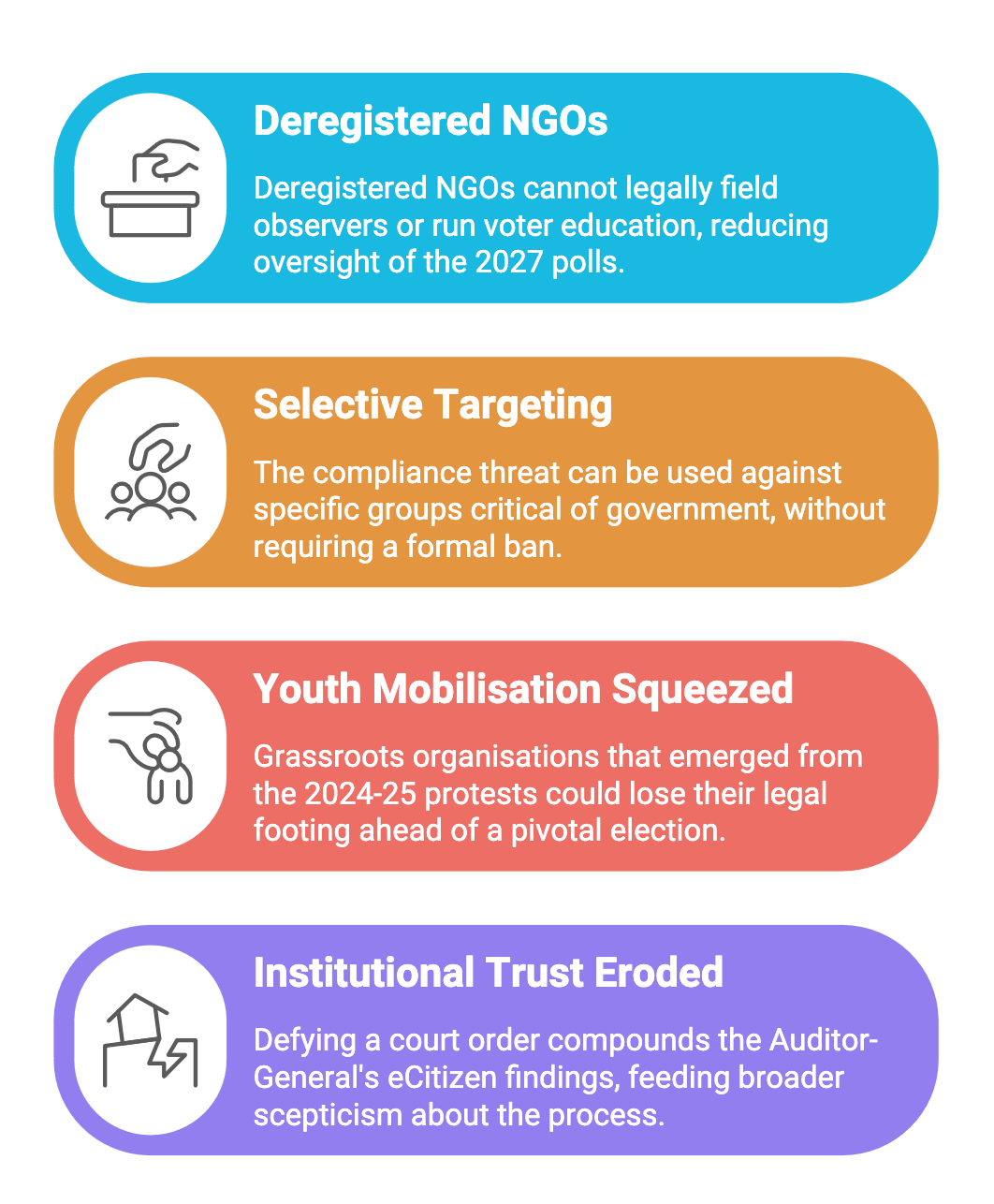
Civil society organizations are usually active actors in the election process, where they run voter education drives, field independent election observers, and serve as one of the few institutional checks on the conduct of the Independent Electoral and Boundaries Commission (IEBC).
The disruption of their legal status, even temporarily, carries real consequences for electoral oversight.
Critics of the government’s posture argue that the timing of this renewed pressure is deliberate. By maintaining the threat of de-registration, the state retains leverage over organizations it may find inconvenient in the election run-up.
The provisions struck down by the court last year had also included requirements to disclose personal information about donors and members, suggesting an interest, at the legislative level at least, in mapping funding flows to civil society.
The youth dimension adds another layer. Since the Gen Z-led protests of 2024, grassroots and youth-orientated organizations have become more politically consequential, with the 2027 Kenya election expected to test their organizing capacity at the ballot box.
Many of these groups depend on the NGO framework for legal protection and donor access. A wave of de-registrations, or even the sustained threat of one, could constrain that mobilization.
What Happens Next
The May 13 deadline will almost certainly trigger further legal action. Organizations that refused to comply after the 2025 ruling have solid constitutional ground to challenge any de-registration notice, and the government would be pursuing enforcement of a requirement a court has already struck down, an unusual posture for any administration to defend.
The more consequential question is whether this episode accelerates a broader deterioration in the space available to civil society in the 18 months before voting begins.
Each escalation, however ultimately unsuccessful, consumes legal resources, management bandwidth, and institutional energy that organizations would otherwise direct at their core mandates.
For now, the ball rests with PBORA and the Ministry of Interior. Their next move will say a great deal about whether the government intends to respect last year’s High Court ruling or contest it by attrition.