







Sometime in the next 18 months, Kenyan politics will enter one of its most turbulent and most watched periods. Coalitions will shift and impeachment drama will simmer or resurface.
The question of who runs in the 2027 elections and on which ticket will dominate chat groups, every political talk show, and, if a small Nairobi-based startup has its way, every prediction market on its platform.
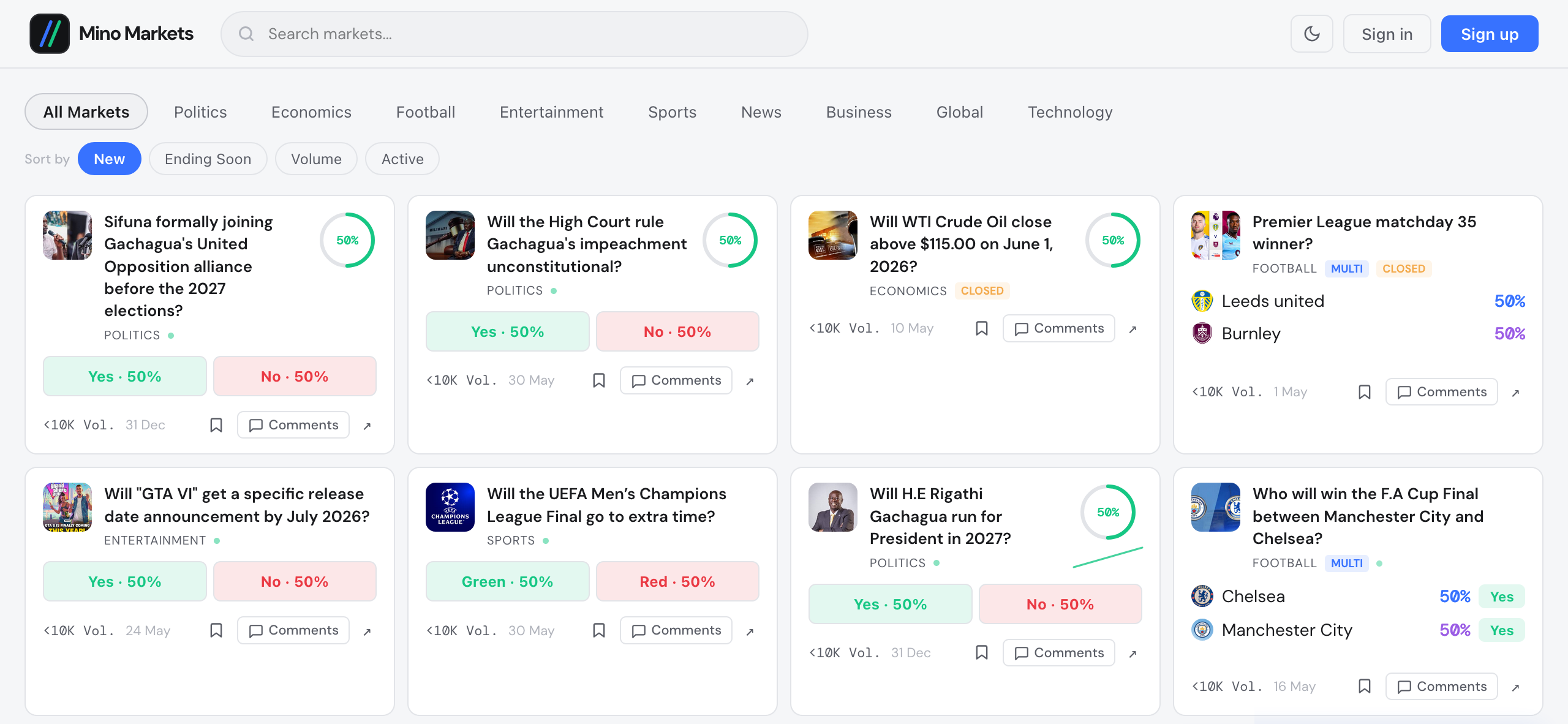
Mino Markets, a Kenyan prediction platform, launched quietly without paid acquisition campaigns or influencer deals. Every user on the platform so far arrived through word of mouth or direct outreach.
The platform is small and has grown entirely on its own. Whether it amounts to anything depends on questions it cannot yet answer.
What Are Prediction Markets?
Prediction markets are not sports betting, though the surface resemblance is enough to cause confusion. Both involve money and outcomes, and both attract the same psychological pull of believing you have a correct read on something.
That is where the similarity ends. In a traditional betting setup, the odds you see on Sportpesa or Betika are not a neutral reflection of probability.
They are engineered by the ‘house’ to build a margin into every market it offers, guaranteeing it comes out ahead across enough bets and enough users. That is not a flaw in the system; it is the system.
Prediction markets work on a different architecture. There is no ‘house edge’ because the odds are not set by the platform but by the participants.
When you enter a prediction market, you are trading a position with other users who hold a different view of how an event will unfold.
The price of any outcome reflects what the collective pool of participants is willing to pay for it at that moment, moving in real time as new information enters and more users take positions.
For example, if you think Gachagua has a 70% chance of running in 2027 and the market is pricing that at 50%, you buy in. If you are right over time, you make money, and if the market is right and you are wrong, you lose.
Your actual read of the situation can matter in Kenya in a way that has nothing to do with luck.
The two dominant global platforms sit at opposite ends of the accessibility spectrum. Polymarket runs on blockchain infrastructure and settles in USDC, meaning any Kenyan with a crypto wallet can technically participate, but the setup requires acquiring stablecoin and managing a wallet before a single trade is placed. Most users will not bother.
Meanwhile, Kalshi uses conventional banking rails but is geographically restricted in ways that make it a non-starter for Kenyan users.
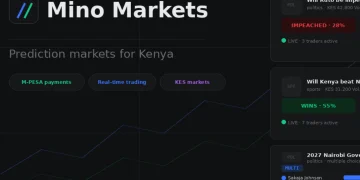
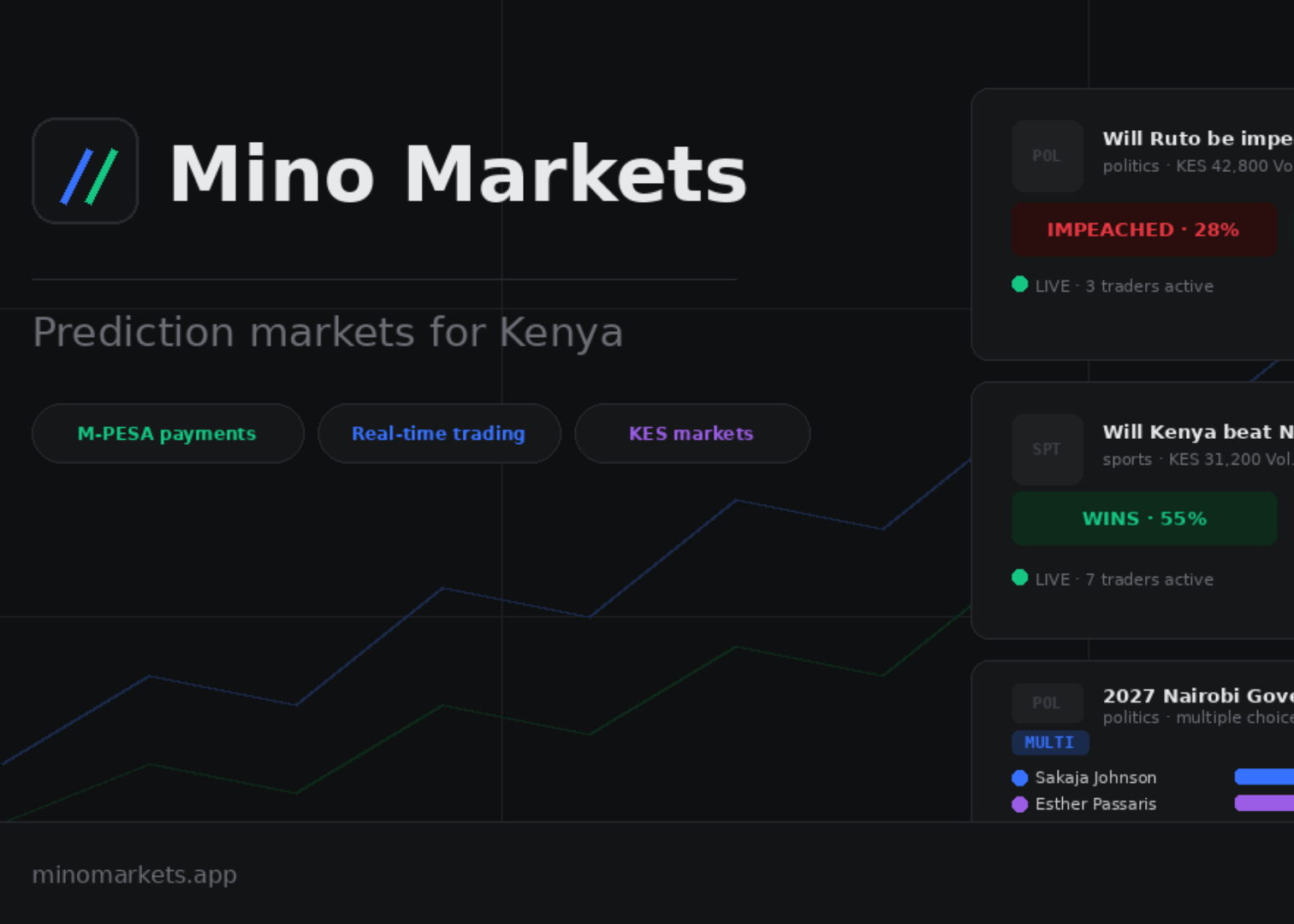
Both platforms were built for markets elsewhere and happen to be reachable from here, under the right conditions. Mino Markets is built for Kenya; it uses Kenyan shillings, settles through M-PESA’s Daraja API, and runs under a registered Kenyan business.
The currency choice removes the crypto friction entirely. It also means the platform carries real regulatory exposure that an offshore crypto-native product does not have to think about.
The Mechanics and the Liquidity Problem
Mino Markets uses a logarithmic market scoring rule, a pricing mechanism that means the platform itself acts as the permanent counterparty on every trade.
What this means is you do not need to wait for another user to take the opposite position before you can enter a market. That design choice is important given that most markets currently show volumes well under KES 10,000.
The mechanism keeps markets technically open at all times, which is a structural advantage over conventional order-book platforms. It does not resolve the deeper problem, though.
Prediction markets only work when enough people participate for prices to reflect broad collective judgment instead of the views of a few active traders.
If only a handful of users are shaping a thin market, the price is not a reliable signal. It is mostly just the opinion of those few users. The developer’s response appears to be intentional concentration instead of expanding participation.
That is a valid strategy, but it also means the platform is effectively waiting for the political cycle to bring in enough activity for those markets to become useful.
“The priority is building real depth on a small number of high-interest markets, Kenyan politics heading into 2027, rather than spreading thin across dozens of niche topics with no community behind them. Depth on the right markets is more valuable than breadth across the wrong ones,” said Martin, the founder of Mino Markets.
What the 2027 Election Changes
Kenya’s 2022 election cycle generated enormous speculative energy across every digital platform in the country. Timelines became informal prediction markets in themselves, with sentiment shifting by the hour as IEBC results came in.
The difference between that informal speculation and a structured prediction market is that the latter attaches a price to belief and disciplines it.
Telling a friend you are 90% sure Sifuna is running costs you nothing. Buying a position at a price reflecting 90% probability requires a different kind of conviction.
The 2027 cycle is already generating that energy more than a year out. The Gachagua question is already open.
His 2024 impeachment and the subsequent political realignment created a landscape where allegiances are fluid and coalition mathematics changes month to month.
Whether he runs, who he aligns with, or whether the Mount Kenya vote consolidates around him or fractures, all these are not rhetorical questions.
They are questions with actual answers that will be revealed over time, and they are precisely the kind of questions prediction markets are designed to price.
For Mino Markets, that cycle is both its biggest opportunity and its most significant test. High-profile political events drive traffic. Traffic drives liquidity, and liquidity makes markets more useful, which attracts more participants.
The flywheel only spins if the platform is credible and sufficiently active when the moment arrives. A platform still finding its footing when the 2027 campaigns peak will struggle to become the reference point it is positioning itself to be.
The Regulatory Shadow
Kenya’s Gambling Control Act came into force in August 2025, replacing the old Betting Control and Licensing Board framework.
The new Gaming Regulatory Authority is still writing its operating rules, which means Mino Markets is operating in a gap the regulator has not yet formally defined.
Prediction markets occupy a contested legal category globally. Singapore classified Polymarket as an unlawful gambling operator, while the Dutch regulator ordered it out of the Netherlands in early 2026, ruling that event contracts constitute illegal gambling.
The platforms argue that trading on information and judgment is categorically different from chance-based gambling. Regulators in several jurisdictions have not agreed.
Mino Markets argues that it functions as a forecasting platform rather than a gambling product, a distinction with real legal implications if it holds.
The platform intends to engage the Capital Markets Authority sandbox as it scales, positioning itself as a participant in shaping the framework rather than waiting for one to land on it.
Whether Kenya’s gambling authority eventually sees prediction markets the same way is a question with no answer right now and one that could change the platform’s operating reality entirely.
Where Mino Markets Stands Now
Mino Markets is already processing real transactions, and its markets reflect issues people in Kenya are actually talking about.
The M-PESA integration is live, its compliance framework is documented, and the platform is clearly built around local conversations instead of imported global trends that mean little to users in Nairobi.
At the same time, it is still an early-stage platform with low trading activity and a small user base. The regulatory environment remains unclear, and much of its relevance depends on a political cycle that is still more than a year away.
That could make this the right time to build. Or it could mean there is not enough time. Mino Markets is betting that 2027 will bring the growth, attention, and validation it needs. It is a reasonable bet, but for now, it is the only one it has.