





Kenya’s appetite for mobile data continues to skyrocket, with the latest Communications Authority (CA) sector statistics revealing that the country consumed more than 620 billion GB of data in the second quarter of 2025.
The surge is being driven largely by the dominance of 4G connections, which now account for 81% of all mobile broadband subscriptions.
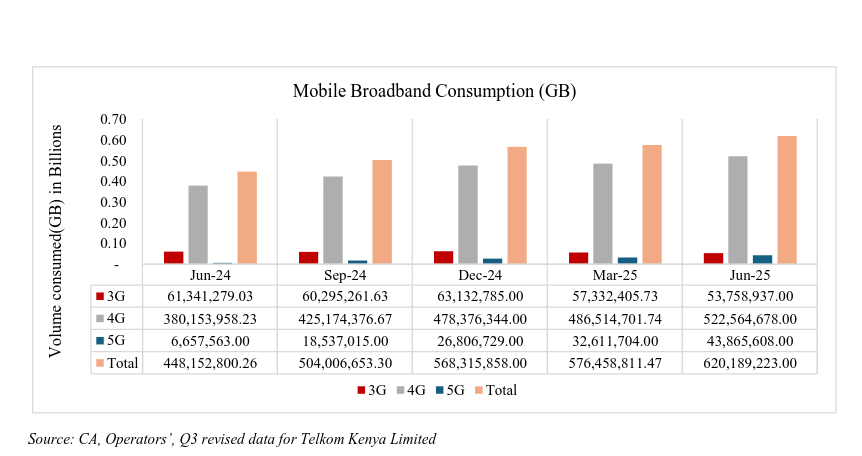
According to the report, 4G remains the backbone of Kenya’s internet ecosystem, as users continue to embrace faster speeds and wider network coverage. The rollout of affordable 4G devices, coupled with competitive data bundles, has helped cement its dominance.
At the same time, 5G subscriptions are steadily gaining traction, reflecting growing adoption of next-generation connectivity.
While still in the early stages, 5G is expected to expand further as operators continue to roll out infrastructure and as smartphones supporting the technology become more accessible.
On average, each mobile broadband user in Kenya consumed 13.5 GB of data per month, an increase compared to previous quarters.
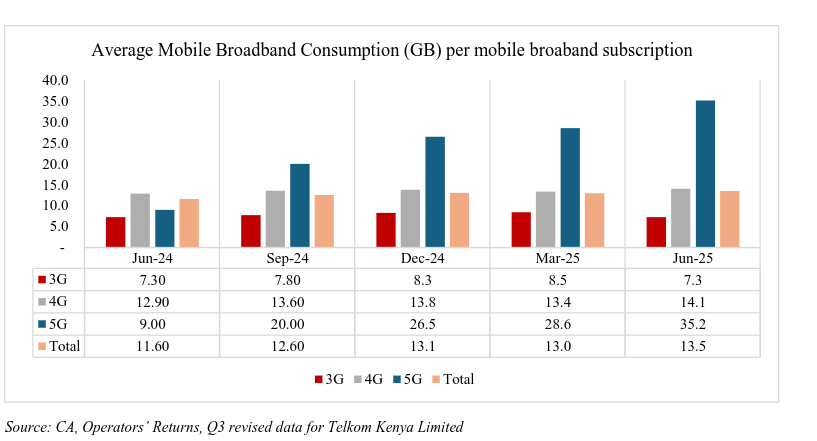
The rise is attributed to video streaming, online gaming, social media, and remote work trends, all of which have changed digital consumption habits.
This aligns with global trends where mobile internet usage is driven by demand for video content, cloud services, and bandwidth-heavy applications.
Broadband Subscriptions Near 56 Million
Kenya’s overall mobile broadband subscriptions now stand at 55.9 million, indicating the country’s rapid digital adoption. 4G leads with the bulk of connections, while 3G subscriptions continue to decline as consumers migrate to faster technologies.
The CA notes that this shift points to a maturing mobile broadband market, with operators competing aggressively on pricing, bundles, and network quality to capture and retain customers.
The surge in mobile data use is being fueled by a mix of factors. The availability of affordable 4G and 5G-enabled smartphones has made high-speed internet more accessible to millions of Kenyans, while video streaming platforms such as YouTube, Netflix, and TikTok remain some of the biggest data drivers.
At the same time, the popularity of online gaming and social media apps continues to push bandwidth demand higher, especially among younger users.
On the infrastructure side, operators are expanding network coverage beyond urban centers into rural and peri-urban areas, ensuring that more people can stay connected and take advantage of faster speeds.