




On January 13, 2026, just 48 hours before Uganda’s general elections, the Uganda Communications Commission (UCC) ordered a near-total internet shutdown across the country.
Mobile broadband, social media platforms, web browsing, e-mail, and virtually all public internet traffic were suspended.
The regulator justified the move as necessary to “curb online misinformation, prevent electoral fraud and incitement of violence, and safeguard public order and national security.”
However, shutting down the internet doesn’t just freeze rumors or keep the streets calm. It creates chaos that stretches far beyond Uganda, hitting the economy, hurting livelihoods, eroding trust, and disrupting democratic transparency right when it is expected to be upheld.
The Role of Telcos: Losses, Compliance, Complicity, and Duty of Care
In the recent internet shutdown, the telecommunications companies (telcos), including major operators like MTN Uganda, Airtel, and Lyca Mobile, swiftly complied with the government’s directive.
From the perspective of regulatory compliance, this wasn’t surprising, as telcos in most African countries operate under licenses that require first and foremost obedience to government or regulator orders on national security matters.
Operators often lack the legal leverage to push back against such directives without risking fines or even license revocation.
But does obedience equate to complicity? And what of the telcos’ duty of care to the people and small businesses who depend on being connected every single day?
MTN Uganda and Airtel Uganda, the country’s largest operators, are estimated to have lost between UGX 22.8 billion (~ $6.4 million) and UGX 24 billion (~ $6.7 million) in data revenue alone during the four-day blackout.
Back in 2021, when the internet was shut down a day after the polls opened, the Uganda economy lost UGX 390 billion (~ $109.7 million) due to internet restrictions.
From the telcos’ side, it’s simple: no internet means no data used. But they still have to pay for cell towers, staff, and maintenance; costs that don’t stop just because the internet does.
In a market where margins are already tight, these forced shutdowns hit their own bottom lines, not just government revenues. However, this technical compliance raises a couple of ethical questions regarding their role in all this:
- Duty of Care vs Regulatory Orders: Telecom providers ideally function as intermediaries between people and the rest of the online world. Therefore, when they enforce shutdowns at the request of the state, are they indirectly being used to violate people’s rights? And are they complicit? Human rights groups and legal activists in Uganda would argue that they are. They argue telcos should answer not just for lost data but for cutting off basic rights to information and freedom of expression.
- Complicity vs Neutrality: International human rights groups have repeatedly described these government-directed service disruptions as violations of freedom of expression and access to information. So when telcos just go along, they’re no longer neutral; they’re taking part, whether they admit it or not.
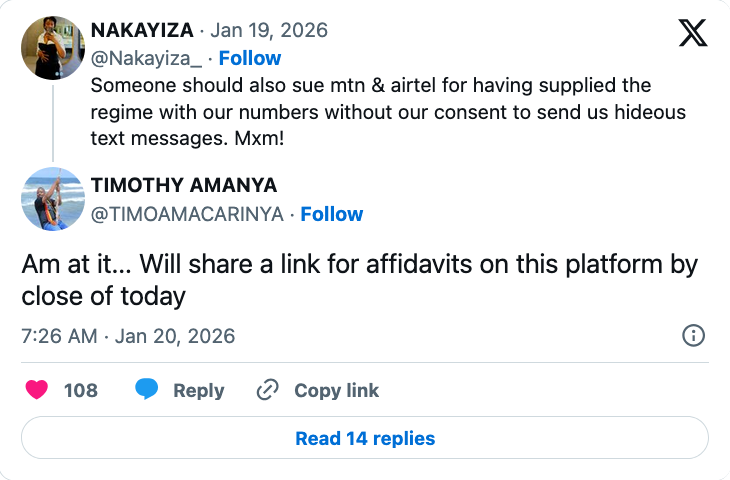
Justifiably, telcos aren’t just obedient carriers; their actions have direct consequences. When they turn off access, they can choke off entire industries.
Losses to Businesses and Everyday Ugandans
For many Ugandans, especially entrepreneurs, gig workers, fintech platforms, and small service providers, the internet is not a luxury; it’s a daily lifeline. When connectivity disappears, so too does income. And these losses come fast and hard.
Digital banks (fintechs) and mobile money services completely stopped. In the 2021 shutdown, fintechs lost at least UGX 66.6 billion (~ $19 million) every single day. Millions of transactions didn’t take place because the internet was gone.
Ride-hailing drivers, e-commerce sellers, delivery people, freelancers, and anyone who relies on real-time connection suddenly had no way to talk to customers, get paid, or do their jobs.
Zimbabwe’s pandemic shutdowns, Kenya’s protest-linked disruptions, and Tanzania’s recent election internet shutdown all showed similar patterns of lost earnings and disrupted operations.
With mobile money and online banking blocked, people had to go back to cash, which made things riskier and slowed down transactions.
Supply chains based on digital coordination, from farmers checking prices to traders coordinating deliveries, suffered disruptions that echoed through the wider economy.
Beyond the obvious financial costs, there’s a more personal toll that’s harder to measure but just as real. Students missed out on remote classes. Online meetings got cancelled while lawyers couldn’t file court documents on time.
READ: Ugandans Are Crossing Into Kenya to Access Their Own Money
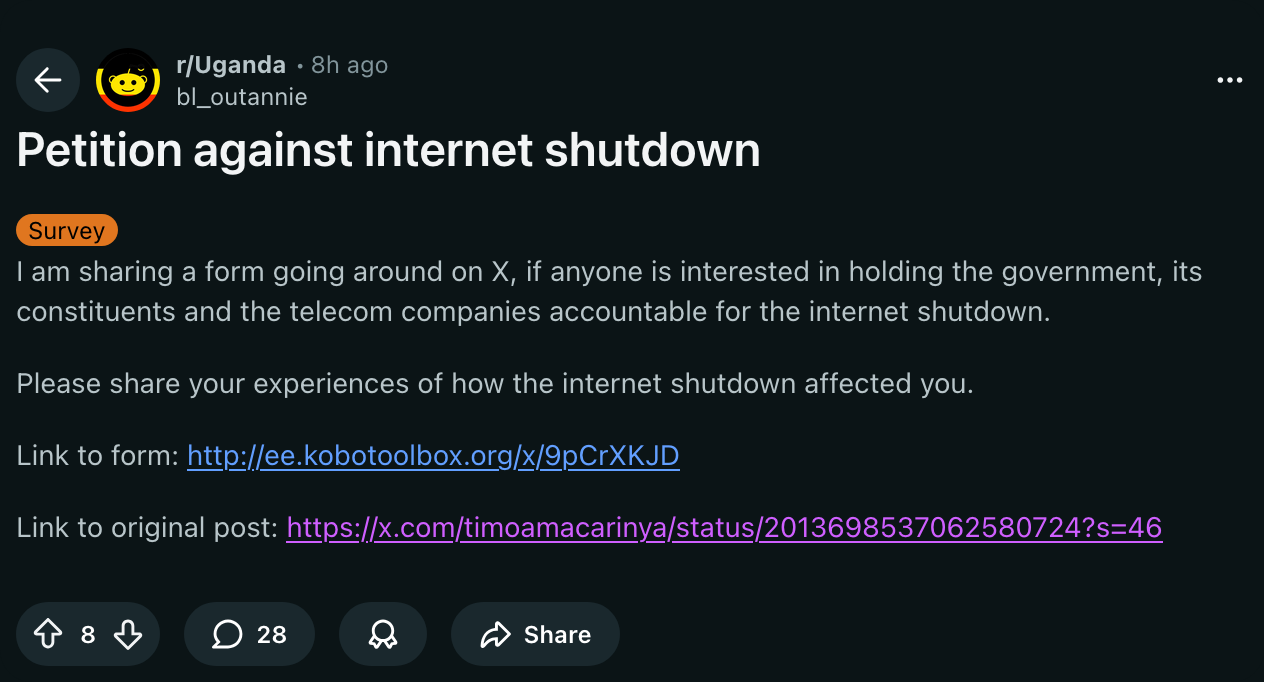
All these setbacks piled up and ended up in a legal challenge against the shutdown. People weren’t just asking for compensation for lost money and data; they want acknowledgement that their academic and professional lives had been disrupted.
People’s Frustrations: Voices from the Ground
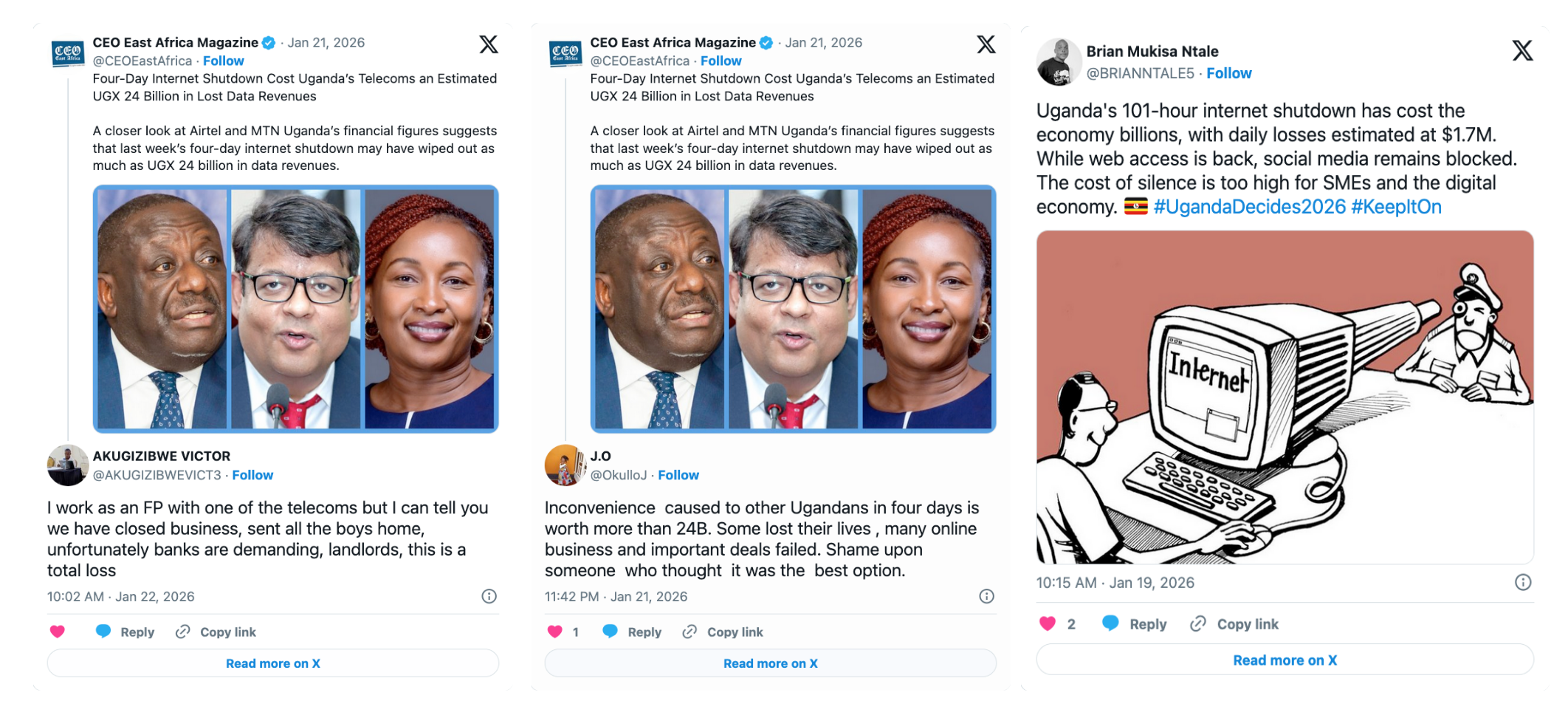
Forget the technical numbers and legal jargon for a moment. If you look at what people actually said online, you get a sense of raw frustration, confusion, and even anger. Ugandans took to social media, venting about more than just inconvenience, once the internet was restored.
For many, the shutdown cut straight into the heart of their daily lives. They talked about being unable to reach family or friends, losing access to essential services, missing work, and being locked out of social networks.
The sense that “there was no justification for shutting down access to tools integral to life, commerce, and democracy.”
Why Internet Shutdowns Are a Go-To Tactic for African Governments and To What End
Uganda’s 2026 internet shutdown is not an isolated case. Research shows that between 2016 and 2024, 41 African countries recorded over 190 shutdowns, with the number increasing year after year.
Ethiopia, Sudan, Algeria, Kenya, and Burundi were among countries with recurring cases.
In Uganda, internet shutdowns and elections go hand-in-hand, having now occurred during three elections in a row: in 2016, 2021, and again in 2026.
READ: How Technology Could Shape Uganda Elections and Why History Matters
Ethiopia has imposed some of the world’s longest and harshest shutdowns, especially during the Tigray conflict, one that lasted over 700 days.
Sudan cuts people off again and again during political chaos and the raging civil war that ensued. Kenya has restricted social media during maandamanos and even exam periods (due to cases of cheating).
Countries like Tanzania, Guinea-Bissau, South Sudan, and Libya have all flipped the switch during political crises, with huge economic losses each time.
This tactic is not unique to Africa. Governments around the world have used internet shutdowns during elections, protests, or security incidents.
In Africa, however, where digital economies are expanding and mobile internet use is rising, the economic, social, and political costs tend to be higher.
So, Is Access to the Internet a Core Human Need?
At this point, internet access is no longer just a “nice to have.” It is increasingly embedded in essential parts of life such as education, banking, civic engagement, healthcare, and social interaction.
The UN and human rights groups are beginning to view access to information and freedom of expression as core to human dignity and democracy.
Human Rights Watch, in its analysis of Uganda’s 2026 shutdown, described blanket internet shutdowns during elections as violations of constitutional and international human rights obligations, including freedom of expression and access to information.
When your ability to learn, work, connect, do business, or take part in politics all depends on being online, cutting off the internet, especially without any open legal process, can legitimately be seen as a violation of basic rights.
Countries that have recognized internet access as a human right, either through court rulings or constitutional interpretation, are grappling with how to prevent arbitrary cut-offs.
In Uganda, those court battles are heating up, with petitioners demanding compensation, data refunds, and real limits on future shutdowns.

The Inevitable Future & Power of Information
We live in the ‘Information Age’ now. Data no longer trickles in; it moves fast, connecting people and ideas across borders that once mattered. Information is no longer controlled by a small elite. New movements can start from a tweet, a livestream, or a message shared in a group chat.
When someone tries to shut that flow down, it is not just an obstacle. It is a push against progress, innovation, and basic freedom. And history shows how hard that is to stop.
Ironically, attempts by governments to silence people often push them to become more inventive. People switch to encrypted apps, use VPNs, explore decentralized tools, or find their own workarounds.
In Uganda, some turned to peer-to-peer messaging apps like BitChat, which rely mainly on Bluetooth and allow communication without standard internet connections.
While these tools are not widely used, their uptake was symbolically important. It showed that even during digital shutdowns, people can and will find ways to stay connected.
Each internet shutdown weakens the government’s control over information. When the next blackout comes, as history suggests it will in some other country, the state may find itself outpaced by a population that has learned how to work around censorship, turning staying connected into a quiet and persistent form of resistance.