






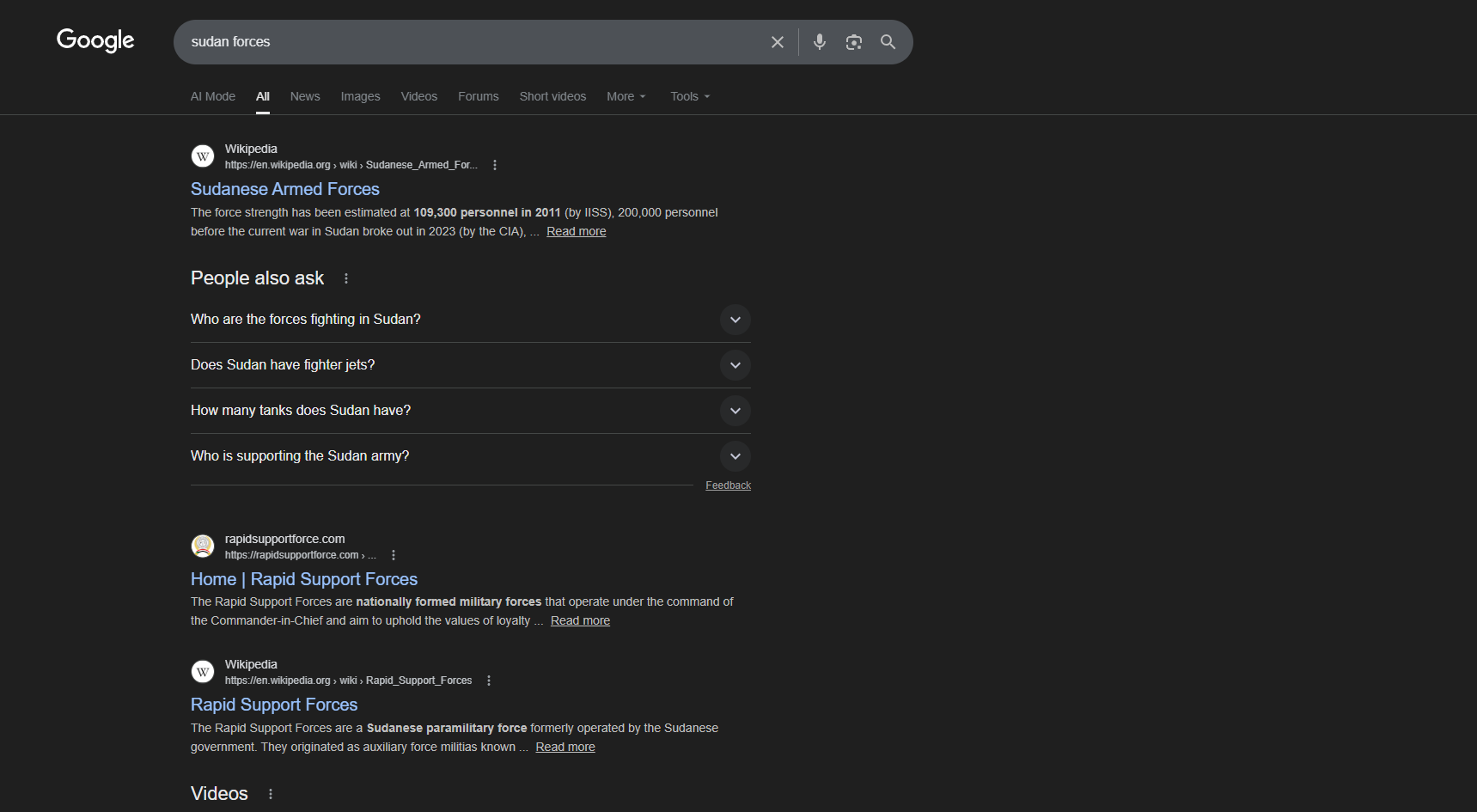
In the middle of one of the world’s deadliest ongoing conflicts, a simple search for Sudan’s armed forces will surface a militia that US authorities have sanctioned and the United Nations has accused of mass atrocities.
The company serving those results is Google, a search giant with over 96% of Africa’s market share.
The Rapid Support Forces (RSF) are a paramilitary group whose senior commanders face UN scrutiny for alleged crimes against humanity.
Evolved from the Janjaweed, the RSF retains the same commanders and brutal patterns of violence that defined the Darfur genocide two decades ago.
In April 2023, the militia reignited conflict in Sudan that has produced what the UN describes as the world’s largest displacement crisis.
Despite this record, the RSF’s official website continues to appear at the top or near the top of Google search results for queries about Sudan’s national army.
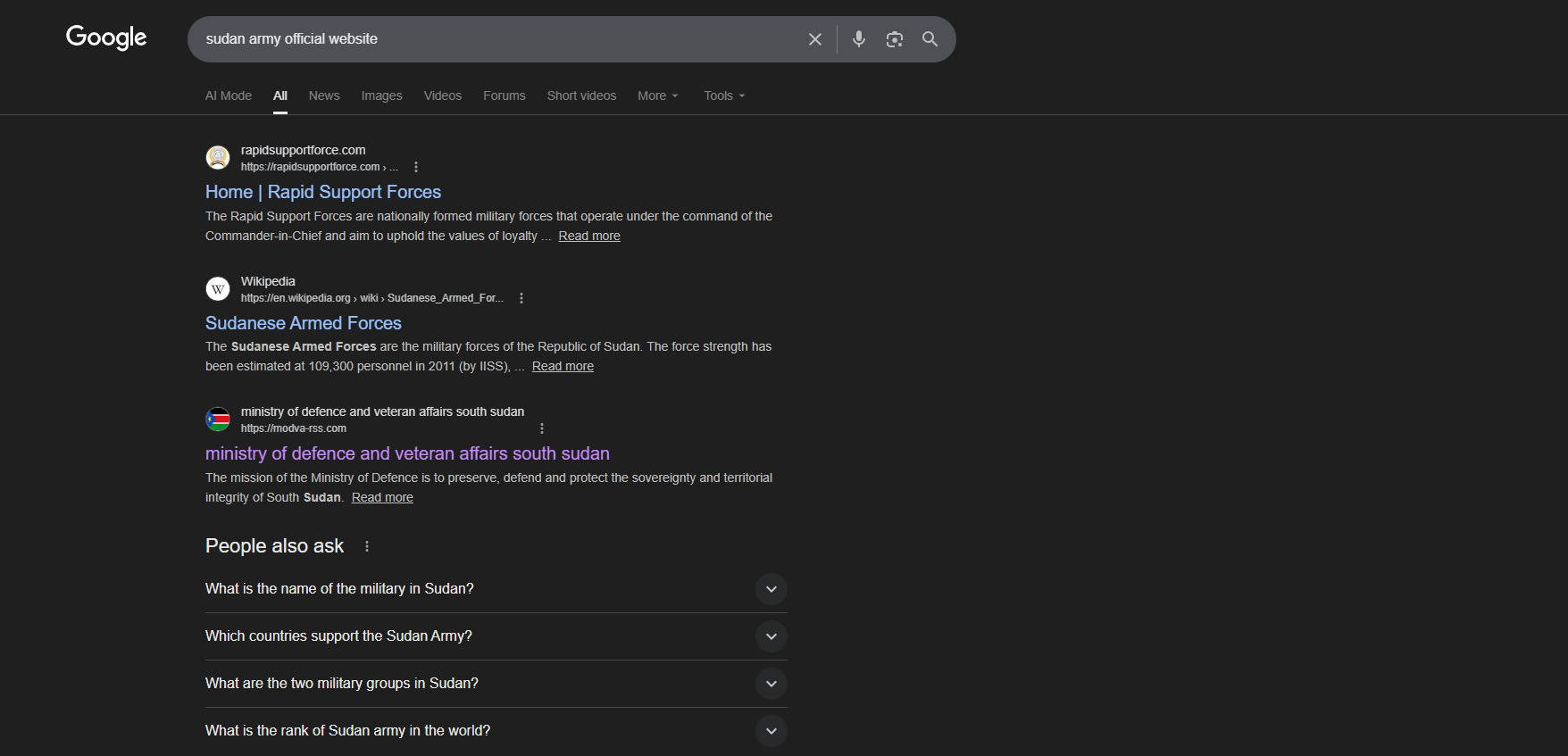
Since the civil war broke out, the RSF leaders have been sanctioned by the United States Treasury and the United Nations Security Council.
In that context, this publication sent detailed questions to Google about sanctions compliance, its policy on armed groups, the risk of propaganda, and when content is removed from search results.
Google’s response: “We are guided by local law and the decisions of courts when it comes to removing pages from our results. We comply with all valid legal removal requests.”
Why Google’s Algorithm Hands the RSF a Default Win
There is a structural factor compounding the problem. The Sudan Armed Forces (SAF) has no official website. At the moment, the public communications appear to be routed through SUNA, the state news agency.
In search engine optimization (SEO) terms, this leaves the RSF’s domain as the only dedicated military presence competing for search queries about Sudan’s armed forces.
Google’s algorithm does not weigh geopolitical context or sanctions status; it rewards authority and optimization. In the absence of a competing official source, the militia’s website, once indexed, wins the ranking contest by default.
According to YouTube, a Google subsidiary, the indexing of the militia’s website brings about what appears to be an internal contradiction as defined by the policy on terrorist content published on its support pages.
“We terminate any channel where we have a reasonable belief that the account holder is a member of a designated terrorist organization, such as a foreign terrorist organization (U.S.) or an organization identified by the United Nations.”
The policy would appear to require exactly the action Google Search has not taken.
The US Treasury’s Office of Foreign Assets Control (OFAC), which has sanctioned the armed group, states that all transactions by US persons involving the property or interests of a blocked entity are prohibited unless specifically licensed.
As a US company, whether indexing and serving traffic to a sanctioned entity’s website constitutes a “transaction” under OFAC regulations has not been tested in court, and Google has not been charged with any sanctions violations.
But the question, one that Google’s own response to this publication did not address, is legitimate and unresolved.
At the moment, the RSF meets both criteria of being flagged by the UN Security Council and sanctioned by the United States government.
This is not the first time Google has been pressed to act on harmful content without a court order, and it is not the first time it has done so.
After the January 6 United States Capitol attack, the Washington Post reported that Google joined other tech firms in removing incendiary content and pledged tougher action against harmful groups.
These were decisions made based on internal harm assessments, not “legal removal requests.”
Further, back in 2017, Google’s own general counsel, unprompted by any legal removal requests, wrote that “there should be no place for terrorist content on our services.”
The post further outlined proactive machine-learning systems to identify and remove ISIS content.
Google’s Definition of a “Bad Actor” Remains Unexplained
On our inquiries, Google did share a blog post on why they remove content from search results. One line stands out: “We’re always evolving our approach to protect against bad actors on the web and ensure Google continues to deliver high-quality, reliable information for everyone.”
Given the documented allegations of killings, rape, and starvation against the RSF by the UN, governments, and other human rights bodies, Google’s threshold for a “bad actor” is yet to be determined.
The threshold question is not hypothetical as Google has demonstrated it will act without court orders when it chooses to.
Andrew Kibe, a Kenyan content creator, had his YouTube channel restricted by Google with no formal complaint from the Communications Authority of Kenya (CA), no court order, and no government sanction.
Kibe is a civilian who divides opinion but has not been accused of killing anyone. The RSF has been accused of massacring 6,000 people in El Fasher alone.
A notable discrepancy exists between the total de-platforming of Andrew Kibe and the preserved search authority of RSF; Google has yet to clarify the policy logic behind this double standard.