






The pay TV sector in Kenya had a rough 2025, with numbers showing it lost 73.2% of its customer base. This sharp decline led to the loss of 4,530,195 subscribers in just 12 months.
Data from the industry regulator, the Communications Authority of Kenya (CA), shows the decline was across broadcast services serving different market niches.
MultiChoice, the South African TV company now owned by Canal+, suffered the biggest loss in the Kenyan market.
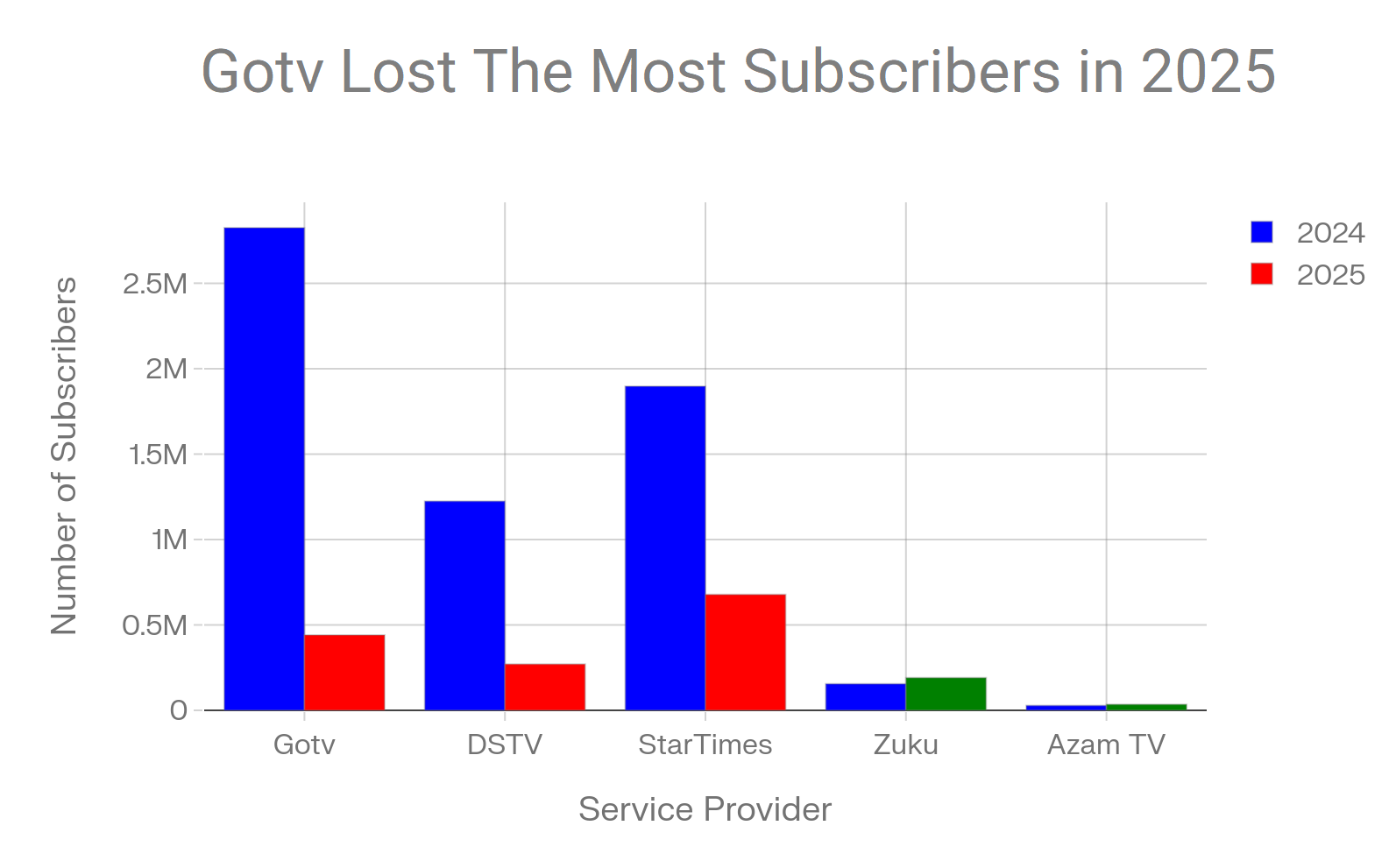
In 2025, its GOtv service, which is tailored to appeal to the mass market, lost 2,384,521 subscribers, dropping from 2,824,896 all the way down to 440,375 customers, a customer base percentage loss of 84.4%.
DStv, another MultiChoice product, finished the year 2025 at just 270,503 subscribers. It lost 954,120 Kenyan customers in just 12 months, representing a 77.9% decline.
Chinese-owned StarTimes was yet another broadcaster with a rough year; it lost 1,218,170 subscribers. The drop from 1,896,616 to 678,446 represented a 64.2% decline.
It was not all bad news for the sector, though. Tanzanian broadcast service Azam TV had a net positive year. Having ended 2024 with 28,190, it experienced a 21.4% growth to finish 2025 at 34,233 subscribers.
Wananchi Group’s Zuku had the largest growth of 23%, increasing its customer base from 154,837 to 190,557. Like DStv, Zuku’s parent company also found new owners in 2025, but Zuku grew while DStv declined.
DStv Price Hike
For DStv, it’s hard to look past its price hikes in the last five years. Its latest hike, in August of 2025, took its premium package to KES 11,700.
Its mid-tier Compact package now costs KES 4,200, more accessible to Kenyans price wise, but many still feel the offering does not justify the price.
Attempts to entice new subscribers by reducing decoder prices did not move the dial either.
In its financial year report, the group cited that increased connectivity is making it easier for customers to access a mix of cheaper content, free content and pirated content; hence, the loss in market share.
CA data does support the connectivity claim; Kenya’s broadband subscription grew by 32.9% in the same period, with the number of smartphones also rising. Fiber-to-the-home (FTTH) subscriber numbers are also on the rise.
To try and arrest the decline, DStv’s new owners are streamlining services by cutting some and relying on strong brands. Canal+ has already shaved off Showmax.
David Mignot, CEO for Africa at Canal+, recently stated, “The group has incredibly strong brands in Africa, but we have too many sub-brands, and that fragments our marketing investments and dilutes the impact.”
The pay TV companies will have to decipher how an increasingly digital-first customer base can migrate to their digital platforms like DStv Stream while facing competition from platforms like Netflix.