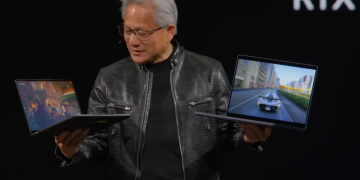








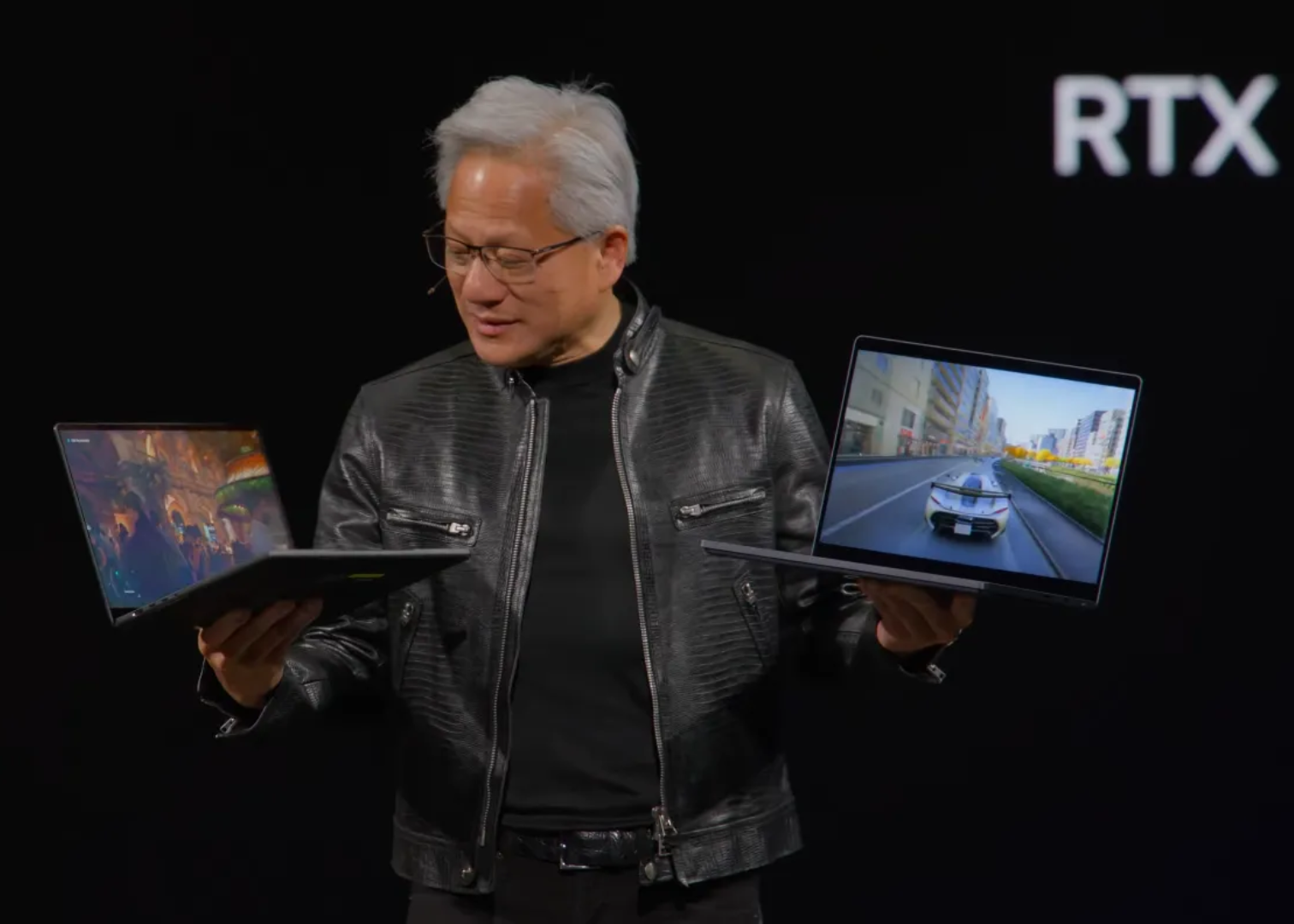
Nvidia makes most of its money selling chips to data centers. Last quarter was another record. The quarter before that was another record. Jensen Huang has been busy. So the announcement of a new consumer laptop chip at Computex this week feels like it comes from a different era of the company, even if the ambitions behind it are very much of the moment.
The chip is called RTX Spark, and it is, in Nvidia’s words, a “superchip.” That kind of language is easy to dismiss, but the specs are interesting enough to give it attention.
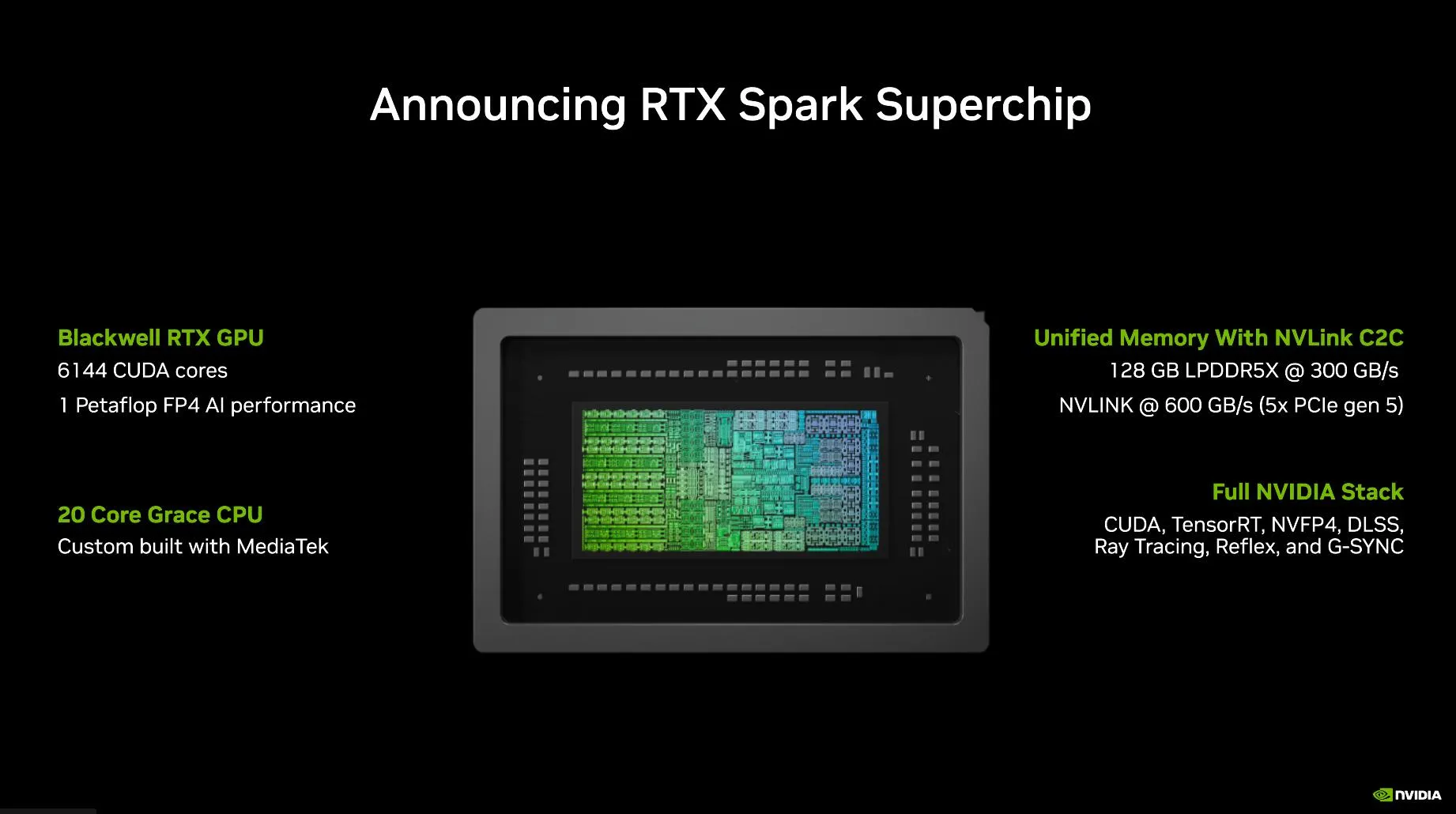
It packs 20 CPU cores, 6,144 GPU CUDA cores based on the same Blackwell architecture as the RTX 50-series desktop cards, and up to 128GB of unified LPDDR5X memory.
READ: Nvidia Unveils the New Gen Gaming Chips: The GeForce RTX 50 Series
Nvidia is also calling it “the most efficient PC chip ever built,” which is the kind of claim that will need benchmarks to back it up, none of which have been shown yet.
The chip is, in essence, a laptop version of the silicon inside Nvidia’s DGX Spark, a tiny developer workstation that currently sells for around $4,700. That context is important for understanding what RTX Spark actually is and what it might cost.
The DGX Spark already went up $700 from its $3,999 launch price, a reminder that the same memory supply crunch Nvidia’s data center business has helped create is now affecting the consumer products downstream from it.
On GPU performance, the 6,144 CUDA cores put the RTX Spark above the mobile RTX 5070 (which has 4,608) but below the mobile RTX 5080 (7,680). The GPU runs at a maximum of 80 watts, compared to up to 250 watts for a desktop RTX 5070.
The tradeoff for slower memory and lower wattage is that the CPU and GPU share all of it, meaning you get over 100GB of addressable VRAM rather than the 8GB or 12GB you’d get from a standard laptop GPU. For anyone running local AI models, that gap is a big deal.
For CPU architecture, the Grace chip underneath combines 10 high-performance ARM Cortex-X925 cores and 10 mid-sized Cortex-A725 cores. There are no small efficiency cores, which makes it more comparable to Apple’s M5 Pro or M5 Max than to the M5 base chip.
This is Nvidia’s first serious swing at the Windows laptop market since the ill-fated Tegra days. The last time Nvidia tried this, Microsoft wrote off $900 million on Tegra-based Surface RT tablets, and the whole experiment quietly died. The Windows on ARM situation has improved dramatically since then.
Microsoft’s x86 translation layer has gotten faster, more major apps ship ARM-native versions, and now Nvidia is working with Riot Games, the developers of Easy Anti-Cheat, BattlEye, and Denuvo, to actually get games running, as per The Verge.
That last part is also important because games with kernel-level anti-cheat have been one of the biggest reasons Windows on ARM has felt incomplete to a lot of users.
The announced laptop lineup for fall includes the Microsoft Surface Laptop Ultra, Dell XPS 16, Asus ProArt P14 and P16, Lenovo Yoga Pro 9n, MSI Prestige N16 Flip AI Plus, and HP OmniBook Ultra, among others.
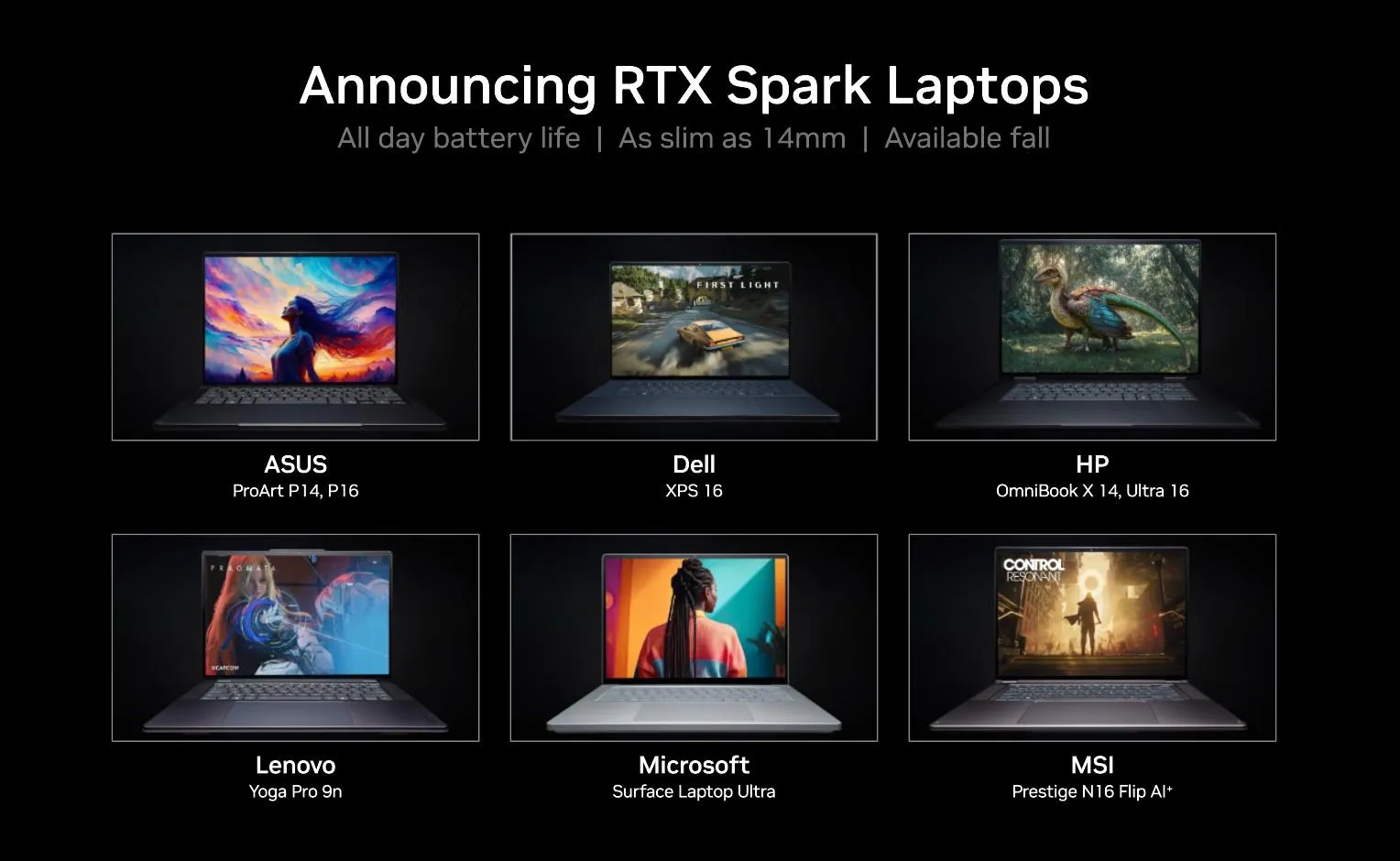
Models like these typically start between $2,000 and $2,500. With 128GB of unified memory, expect the top configurations to push well past that.
That pricing is where the comparison to Apple’s M1 launch in 2020 breaks down. Apple introduced the M1 in the MacBook Air, the Mac Mini, and the cheapest MacBook Pro. Ordinary buyers felt it immediately. Developers had immediate incentive to optimize for the new chips.
RTX Spark is skipping straight to the expensive end. If Nvidia’s entry into this market starts at $2,500 and goes up from there, it won’t be the kind of platform shift that changes what most people use.
Jensen Huang was characteristically expansive about what all of this means. He wants PCs where you stop launching apps and typing commands and instead just ask the computer to do things.
The RTX Spark machines will run AI agents locally in secure sandboxes developed with Microsoft, and over 100 software companies have signed on to support the chip, including Adobe for Photoshop and Premiere.
There will also be lower-end RTX Spark chips. Leaked specs point to a smaller chip with up to 12 CPU cores and 2,560 CUDA cores, supporting up to 64GB of RAM and running at 45 watts.
That could eventually land in thinner, more affordable laptops, but nothing in that range has been announced for fall.
The Windows laptop market will have four chip options this year: Intel, AMD, Qualcomm, and now Nvidia. AMD tends to offer strong performance with some battery life tradeoffs.
Qualcomm offers the best battery life but weak game support. Intel is usually a balanced option with full x86 compatibility. Nvidia, if everything works as advertised, could offer strong battery life, serious GPU performance, and better gaming on ARM than anything that’s come before. That would be a very useful addition to the market.
The outstanding question is price. If these machines land at $2,000 to $3,000+, they become a product for a specific kind of buyer: developers running large language models locally, creative professionals who want fast local AI inference, and high-end gamers who also want the ARM experience.
That’s a real market, but it’s not the broad platform shift Huang is describing in his keynotes. For that, Nvidia will eventually need to get this chip into something people can actually afford.