






AI tools have made it possible to script, narrate, and edit a video without ever picking up a camera, and creators everywhere have started leaning on that shortcut.
Platforms have responded not by banning the tools but by drawing a sharper line around what still counts as a person’s own work, and that line shows up clearly once you compare two videos side by side.
Picture two YouTube channels that publish a video called “The 5 Best Phones Under KES 30,000” in the same week.
One creator spends seven days living with each phone, shooting their own camera samples, forming an opinion on which compromises actually matter for someone paying that price.
The other feeds the spec sheet into an AI tool, gets back a script and a synthetic voiceover, and layers stock footage underneath.
Both videos disclose that AI was involved somewhere in the process, and both look equally polished on a thumbnail.
READ: Creators Slam YouTube for Quietly Altering Their Videos With AI
The difference is that platforms are increasingly separating AI-assisted work from content that is largely generated and published with little meaningful human input.
What Platforms Are Anxious About
Across YouTube, Meta, TikTok, Snapchat, X, LinkedIn, and Pinterest, the concern is broadly the same: how to deal with a flood of AI-generated content without making their platforms less trustworthy or less useful.
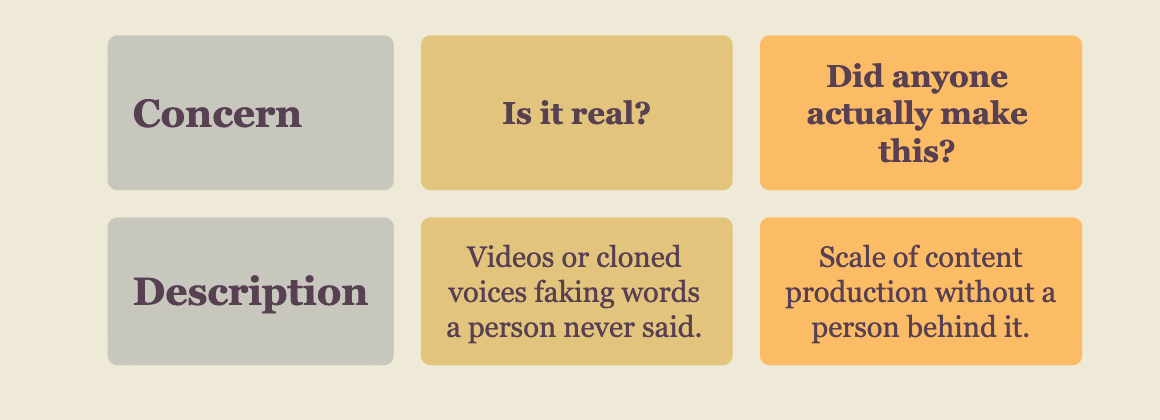
Platforms are worried about two general issues.
First, is it real? Think of a video edited to make someone say words they never said, or a cloned voice reading a line the real person never recorded. That’s the fear behind every disclosure rule, and it applies whether a human or an AI faked it.
READ: Podcasters Get New AI Tools as YouTube Expands Studio Features
Second, did a person actually create it? AI can now let one person produce dozens of videos with little more than a prompt and a click to publish. The concern is not necessarily deception, but volume: feeds filling up with repetitive, automated content with little meaningful human input.
Underneath both issues, platforms are trying to protect three simple things:
- Realistic content is actually real
- Genuine work gets seen
- Feeds don’t drown in copies of the same thing
Break any of those and you risk getting flagged, whether that’s a fake clip passed off as real, duplicated content, or a posting pattern that looks like a factory line instead of a person.
READ: Anthropic Adds Invisible Watermarks to Claude AI-Generated Text Worldwide
The trend, then, is not that platforms are simply restricting AI. They are increasingly asking a different question: did AI help the creator make this, or did it replace the creator altogether?
How Platforms Draw the Line
| Platform | Its version of “Originality” | Its version of “Automation” |
| YouTube | Meaningful commentary, substantive modification, real educational or entertainment value | Inauthentic, generic, repetitive videos and reused clips without transformation |
| Meta | Content filmed or created by the publisher, or third-party material with real added value | Duplicated posts, borders, basic captions, simple narration, non-commentary reactions |
| TikTok | Content filmed, designed and produced by the creator, with personal creative contribution | Copied videos, slight modifications, Duets, Stitches, compilations without new ideas |
| Snapchat | Sophisticated editing or AI-based tools used with genuine creative effort, disclosed | Simple automation, formulaic template assembly, unoriginal curation |
| X | A genuine account free of deception, fraud, spam or manipulation | Undisclosed AI-generated depictions of real events, particularly armed conflict |
| A post with a clear, identifiable point of view from a real person | Generic AI-written posts, automated comments, bot-driven profiles | |
| Human-curated inspiration a person can act on | AI-generated or AI-modified pins flooding search results as “AI slop” |
Why Disclosure Alone Doesn’t Save the Content
This is where the two issues split apart most clearly.
Disclosure answers the deception question, whether the viewer knows AI was involved, the same way a “sponsored” tag tells them a post was paid for.
Originality answers the flooding question, whether this particular piece deserves the reach it is asking for.
A creator can disclose their use of AI and still lose reach if the video itself is largely templated, such as a synthetic voiceover layered over stock footage. Disclosure addresses whether the audience was misled, not whether the content is original enough to be rewarded.
| Original | Unoriginal | |
| Disclosed | Stays visible, can monetize. An AI-narrated explainer built on the creator’s own research and opinion | Reduced reach, monetization at risk. A labeled but templated voiceover over stock footage |
| Undisclosed | Rare in practice, still exposed to scrutiny once discovered | Highest-risk violation. A synthetic clip of a real event presented as authentic |
YouTube states outright that disclosure alone does not remove a video’s eligibility to earn money.
Meta keeps labeled content online unless it breaks another rule. The penalty never comes from admitting AI was used; it comes from failing the originality question regardless of what a creator discloses.
Back to the Two Phone Reviewers
Run both channels back through this framework, and the outcome stops looking arbitrary.
The seven-day reviewer passes both tests: nothing is deceptive, and a clear person is making editorial calls a viewer can disagree with.
The AI-pipeline channel may pass the deception test simply by disclosing AI use and still fail the flooding test the moment its tenth near-identical video in a month lands in front of a moderator or an algorithm trained to spot the pattern.
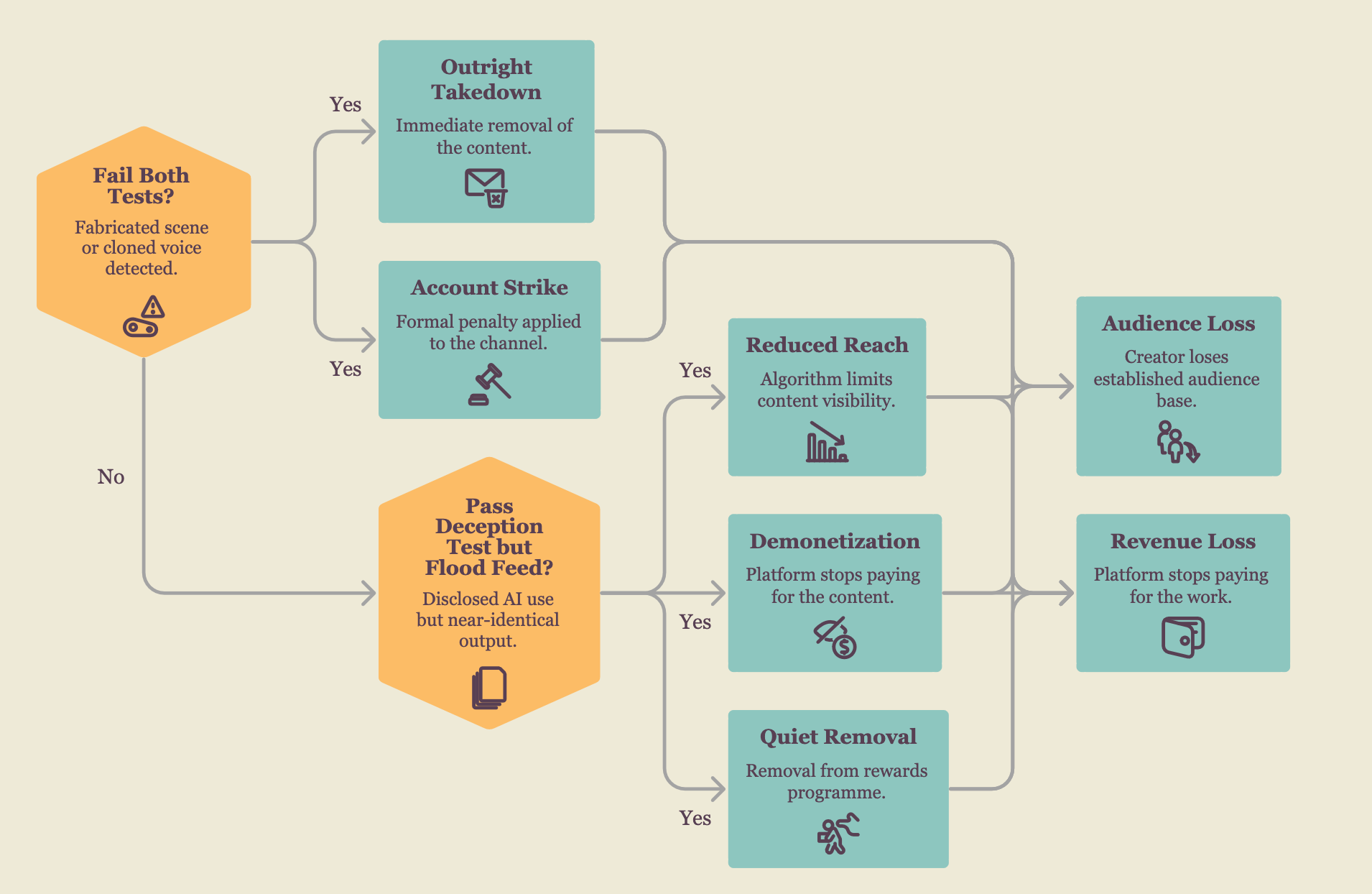
Fail both tests at once, and the consequences stack. A video built on a fabricated scene or a cloned voice risks an outright takedown or an account strike, regardless of how well it performs.
READ: YouTube Declares War on Low-Effort AI Videos via Demonetization
A channel that passes the deception test by disclosing AI use but still floods a feed with near-identical output loses the softer way: reduced reach, demonetization, or quiet removal from a rewards program, even without a single rule technically broken.
Either way, the audience a creator spent months building stops seeing their work, and the platform stops paying for it.
For anyone building an audience online, that makes the safer path obvious. Use AI as a hand on production rather than the source of the idea, the way a solo creator already leans on an editor or a thumbnail designer.