









Millennials don’t actually hate OTT (Over-the-Top) phone calls like WhatsApp, and Gen Z doesn’t love them more.
On X recently, there was a conversation on how millennials don’t accept WhatsApp calls and prefer “normal’ circuit-switched voice calls on cellular networks.
The assumption is wrong, and data shows that we live in a world where connectivity has outpaced traditional telephony. The decline of the standard voice call isn’t about age; it’s about moving where the technology is.
Between that year and 2007, international voice traffic grew at a compound annual growth rate (CAGR) of 15%, with an even faster 21% CAGR recorded between 1927 and 1983.
For nearly a century, voice was how the world communicated at a distance, and telecoms companies built empires around billing for every minute.
Then came the smartphone, WhatsApp, and the collapse of everything that had been built.
When the Voice Decline Began
International voice traffic peaked in 2014, and since then, it has declined every single year.
TeleGeography, a telecommunications data firm, tracked a 7.0% drop in 2024 alone. Wholesale carrier voice traffic has fallen to approximately 284 billion minutes, down from a peak exceeding 500 billion minutes.
WhatsApp rolled out voice calls in early 2015, a year when most Gen Z may not have been old enough to be allowed to own a phone. By 2016, OTT traffic had surpassed international carrier voice traffic.
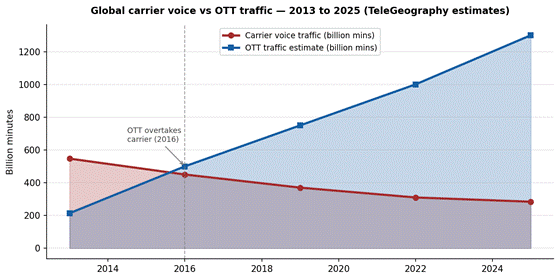
“It’s hard to believe that the recent decline in traffic means that people have lost interest in communicating with friends and family,” TeleGeography notes in its 2026 State of the Network report. “Rather, it suggests that they are turning to other means.”
Safaricom’s Voice Revenue Tells the Story
A look at Safaricom numbers, the dominant telco with over 63% mobile market share, shows the global trend plays out with precision in Kenya.
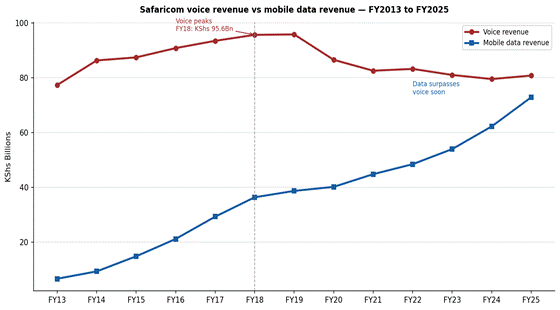
Safaricom’s voice revenue rose steadily from Kshs 77.3 billion in FY2013 to a peak of Kshs 95.6 billion in FY2018. It has not come close to that figure since.
| Safaricom voice peak KES 95.6Bn FY2018 — never recovered | OTT overtook carriers 2016 TeleGeography estimate | WhatsApp penetration 54.4% of Kenyans — Q4 FY2024/25 |
By FY2025, voice revenue stood at KES 80.8 billion, down 15.5% from its peak. The decline mirrors the global trajectory almost exactly, with a peak around 2014-2018 depending on the market, followed by sustained erosion.
The transition to calls over OTT apps is best illustrated by the surge in Safaricom’s mobile data revenue climbing from KES 6.6 billion in FY2013 to KES 72.9 billion in FY2025.
This represents an eleven-fold increase over a twelve-year period.
Based on this trajectory, mobile data revenue is set to surpass voice for the first time in the company’s history within the next financial year.
Connectivity Made OTT Calls Popular
Kenya’s mobile connectivity has expanded aggressively, creating the conditions for OTT adoption at scale.
The Communications Authority of Kenya (CA) reports that mobile SIM subscriptions reached 78.3 million in the first quarter of FY2025/26. The country also has 44,653,325 smartphones in active use.
On fixed data, Kenya’s total subscriptions stand at over 2.27 million, with Safaricom leading at 35.6% market share. Total available international bandwidth capacity stands at 22,311 Gbps, a figure that has remained stable as utilized capacity continues to grow.
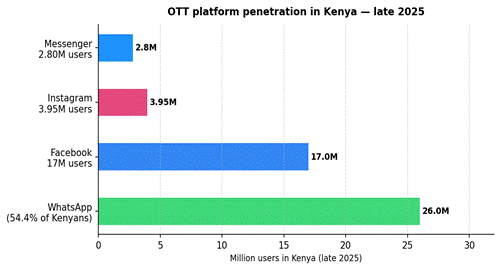
The connectivity infrastructure has delivered Kenyans directly into the hands of OTT platforms. According to data from the CA, 54.4% of Kenyans were using WhatsApp in the fourth quarter of FY2024/25.
Meta’s footprint in Kenya keeps growing, with Facebook hitting 17 million users, while Instagram and Messenger account for 3.95 million and 2.80 million users, respectively.
These platforms offer voice calls, video calls, and messaging.
It is no surprise that Airtel Africa, while piloting its satellite mobile service in Kenya, started by testing the network’s capability to support calls on WhatsApp and Facebook Messenger.
For a Kenyan caller, WhatsApp is definitely cheaper than a traditional call. For some users, it is the only option they consider.
Data doesn’t give us an age split on how generations make calls. However, revenue and minute trajectories give us a solid picture of what kind of calls are preferred today.
The person making a WhatsApp call is not doing so because they are Gen Z, and it’s not a technological novelty.
They are the endpoint of a decade-long restructuring of global communications that has permanently transferred value from the network operator to the OTT platforms.