







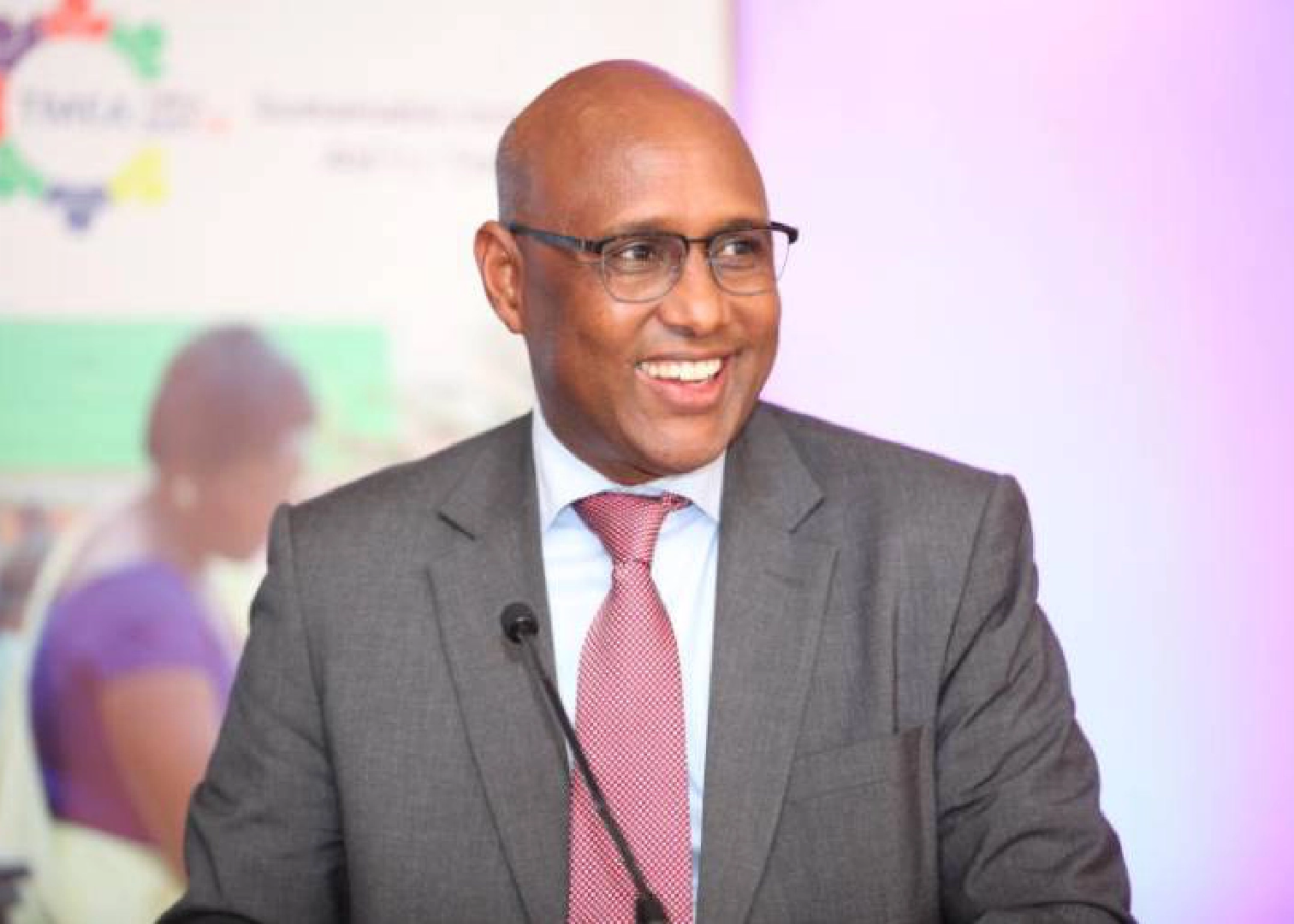
Kenya’s taxman has a new face at the top. On May 18, 2026, Treasury Cabinet Secretary John Mbadi appointed former Industrialization Cabinet Secretary Adan Mohamed as the new Commissioner General of the Kenya Revenue Authority (KRA).
Mohamed replaces Humphrey Wattanga, who was ousted last month and subsequently posted as Kenya’s envoy to Canada.
The appointment formalizes what has been an open question at Times Tower for weeks: What kind of leader does KRA need, and is Mohamed that person? The answer, however, depends heavily on an honest reading of where Wattanga left things.
What Wattanga Built, and Where It Broke
Humphrey Wattanga arrived at KRA in August 2023 with a clear mandate. Poached from the private sector, he was tasked not only with boosting tax collection but also with transforming the image of an agency perceived as harsh and repressive.
His response was a hard pivot toward technology. Under his watch, KRA deployed the Electronic Tax Invoice Management System (eTIMS) for real-time transaction monitoring, launched GavaConnect as an enterprise API platform allowing developers to embed tax compliance directly into business software, and rolled out AI-powered validation tools to scrutinize income and expenditure claims.
The ambition was sound, looking to close loopholes by making taxes invisible in the fabric of commerce, rather than bolt-on and burdensome.
Wattanga’s record was complicated. He became the first Commissioner-General to deliver double-digit revenue growth, pushing collections to KES 2.407 trillion for the financial year ending June 2024, an 11.1% jump on the previous year. On paper, that is a strong result.
The problem was that the target set for him was higher still, leaving a 4.5% gap that the board could not overlook. He was growing the numbers, just not fast enough to keep pace with what the government needed.
The gap between what was collected and what was expected persisted throughout his tenure, and that gap may have ultimately been what cost him the job.
However, the deeper problem was the technology itself. The systems Wattanga championed as transformation tools kept breaking down at the worst possible moments.
The iTax portal went dark on June 30; the Integrated Customs Management System (iCMS) was down for six days in November 2024; and the system tied to eCitizen went down for more than 30 hours in September 2025, locking thousands of small businesses out of invoicing and payment processing at a time when KRA was desperately trying to widen the tax net.
Treasury CS John Mbadi, while in the same room as Wattanga at the KRA Summit 2024, told the audience that iTax was outdated and iCMS was not working.
KRA missed its Q1 2025/26 target by KES 90 billion, with the fiscal deficit ballooning to KES 280 billion in a single quarter. One day before his ouster, Wattanga held a press conference announcing plans to collect KES 932 billion in the final quarter through WhatsApp chatbots, eTIMS, and USSD services.
He sounded, as one account noted at the time, like a man making a final pitch to a board that had already decided. Treasury officials felt he was not doing enough on the technological front to justify the huge tech investments, and system downtimes had surged.
As a result, he was asked that morning to resign, and although he declined, the board moved him out by afternoon.
It was not entirely his failure. Wattanga inherited broken systems, a business community raw from aggressive enforcement, and a public that had just watched Parliament nearly implode over the Finance Bill 2024.
The informal sector, where more than 19 million Kenyans remain largely outside the tax net, proved resistant to digital mandates designed primarily with formal businesses in mind.
Still, the overriding verdict from the board was unambiguous that results were expected, and they did not come consistently enough.
What Mohamed Brings to KRA
Adan Mohamed’s profile is a deliberate contrast. He previously served as Managing Director for Barclays East and West Africa and Chief Administrative Officer for Barclays Africa, overseeing operations across ten countries.
He then served as Cabinet Secretary for Industrialization under President Uhuru Kenyatta, where he championed the Kenya Industrial Transformation Program and worked to improve the country’s ease of doing business.
Under President William Ruto, he was appointed Chief of Strategy Execution in the Executive Office of the President, overseeing the implementation of government programs and coordination of key policy priorities.
Where Wattanga was a technocrat who believed systems could replace compliance culture, Mohamed is a strategist whose background sits in boardrooms and policy corridors rather than enforcement floors.
It is not yet clear whether this will lead to a more business-friendly approach. His public record suggests he is more focused on setting direction than handling complaints.
Manufacturers, importers, and MSMEs still affected by the eTIMS rollout may find the new leadership at Times Tower more directive than consultative.
Mohamed takes over an agency expected to deliver stronger collections while avoiding further strain on economic activity, with Parliament currently debating proposals under the Finance Bill 2026 aimed at widening the tax net and tightening compliance measures.
The political environment has not softened. Ruto’s administration still needs revenue, and the pressure on KRA has not eased simply because the face at the top has changed.
The Digital Infrastructure Is Not Going Anywhere
It would be a mistake to read this transition as a repudiation of digital tax administration. eTIMS, for all the friction it caused, has measurably improved VAT compliance and made missing-trader fraud schemes harder to sustain.
READ: KRA Is Tracking Traders Switching Till Numbers to Evade Taxes
The GavaConnect API infrastructure, the mobile-first USSD and WhatsApp platforms, and the AI validation tools are now embedded in how KRA operates; Mohamed inherits all of it.
His job is not to undo what Wattanga built, but to make it function as it was meant to. That includes completing the unfinished iTax and iCMS upgrades, addressing ongoing system downtime that has hurt confidence, and adjusting enforcement so compliance is realistic rather than punitive, especially for small businesses.
The mandate to grow the tax base into the informal sector is unchanged. What may change is the route taken to get there.
Observers say Mohamed’s appointment comes at an important time for fiscal management. The expectation is that the new leadership will focus on improving efficiency, expanding compliance, and modernizing tax systems to strengthen revenue collection.
READ: KRA Pushes Mandatory eRITS Registration for Landlords After Missing KES 80 Billion Target
Kenya needs its tax authority to raise more revenue, but it also needs stronger economic growth to widen the tax base. For the first time in a while, the role may be filled by someone who understands both priorities and how they connect.