









Zuku has doubled the speeds on all its home internet fiber packages without changing any of its prices. What’s surprising is there was no press release or announcement on its social media handles. The website was just updated quietly, and that was that.
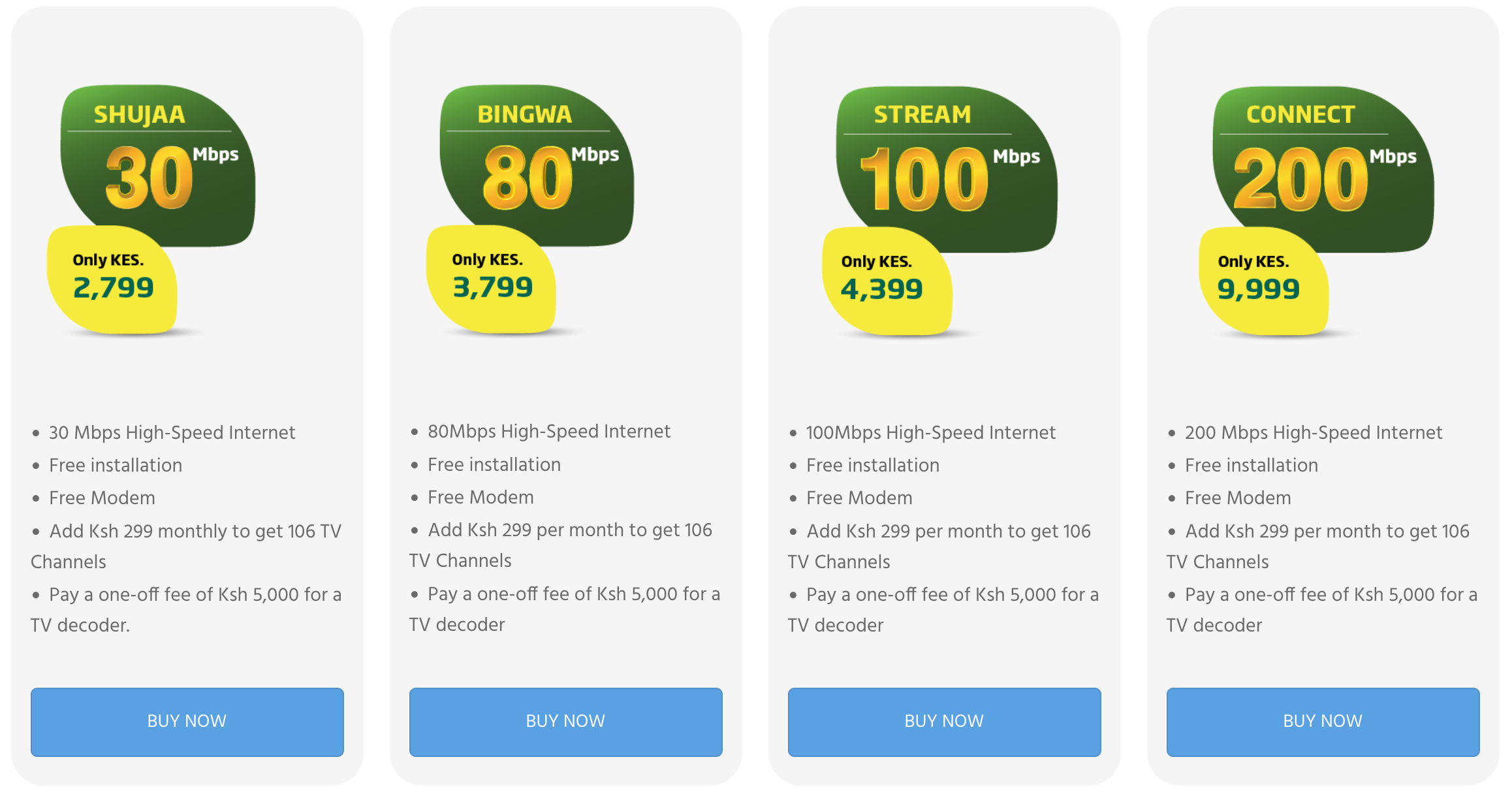
As it stands, Shujaa, the entry-level plan at KES 2,799, goes from 15Mbps to 30Mbps. Bingwa at KES 3,799 moves from 30Mbps to 80Mbps.
Stream at KES 4,399 jumps from 50Mbps to 100Mbps. Meanwhile, the top Connect package at KES 9,999 doubles from 100Mbps to 200Mbps.
| Plan | Monthly Price | Old speed | New speed | Change |
|---|---|---|---|---|
| Shujaa | KES 2,799 | 15 Mbps | 30 Mbps | 2x faster |
| Bingwa | KES 3,799 | 30 Mbps | 80 Mbps | 2.7x faster |
| Stream | KES 4,399 | 50 Mbps | 100 Mbps | 2x faster |
| Connect | KES 9,999 | 100 Mbps | 200 Mbps | 2x faster |
To understand why this happened, you have to look at what the rest of the market has been doing.
Airtel Kenya launched Xstream Fiber with plans starting at KES 1,999, which immediately made it the most affordable entry point in the fixed broadband space.
Safaricom responded by upgrading its Home Fiber speeds, but buried inside that move was a separate change that got far less attention: the company cut its Fair Usage Policy limits across every package, in some cases by 90%, and told nobody. Bronze subscribers went from a 15TB monthly data cap to 1.5TB.
Zuku’s answer to all of this was to give its current customers more speed without touching the bill. It is a clean move, and more importantly, it does not come with any visible policy changes attached.
Whether those speeds actually deliver is a whole other conversation. According to nPerf’s annual barometer for April 2025 to March 2026, Zuku ranked fourth out of five major fixed internet providers.
Its download speed grew 39% year-on-year to 35.35Mbps, which placed it second only to Faiba in that specific category. Everything else, upload speed and latency in particular, was decent but not remarkable.
Faiba, run by Jamii Telecommunications, has been the standout performer across the board. Its overall nPerf score increased, and it led in every measured category except latency. No other operator came close.
VGG Connect held second place largely on the strength of its latency numbers, the lowest in the sector for five straight years, though its download and upload speeds are the weakest in the group.
Safaricom sat third with steady improvement across the board. Airtel came last, posting the worst latency and the lowest browsing scores despite having the most competitive entry pricing.
For Zuku subscribers, the speed upgrade costs them nothing and appears to come without conditions, at least for now.